

Active Graph
Active Graph is an event-sourced, reactive graph runtime for long-running, auditable AI agent systems, where behaviors react to a shared graph instead of messaging each other, and every run is resumable, forkable and diffable from its event log.
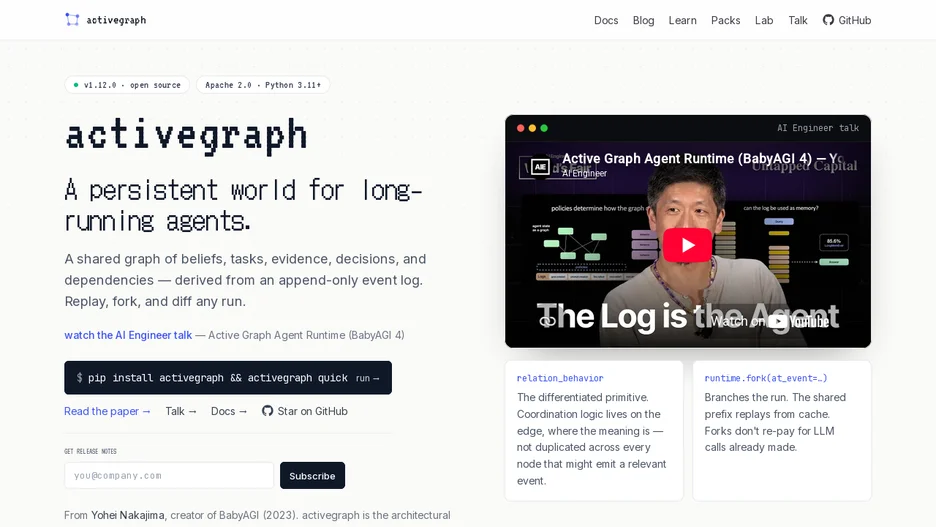
Active Graph structures an agentic system as behaviors reacting to a shared graph rather than as agents exchanging chat messages, so every change to the system is traceable to who made it and why. Because the graph's state is built from an event log, a run can be resumed, forked or compared against another run's log, giving an auditable trail for long-running systems.
A bundled Diligence pack runs against recorded fixtures with no API key, configuration or network access, producing byte-deterministic output so a user can see what the framework does before reading how it works; an interactive quickstart scaffolds a behavior, runs it against the same fixtures, and walks through the fork-and-diff workflow. A separate open pack library adds about 20 additional packs, demo bundles, a demo server and a React inspector UI.
It installs with pip, is written in Python, and is licensed under Apache-2.0.