

agency-agents (Chinese edition)
A Chinese-language collection of 277 ready-to-use AI agent personas covering roles such as CEO, CTO, engineering, design, marketing and finance, for use with Claude Code, Cursor, Copilot and other coding tools, with an orchestrator that runs several agents together.
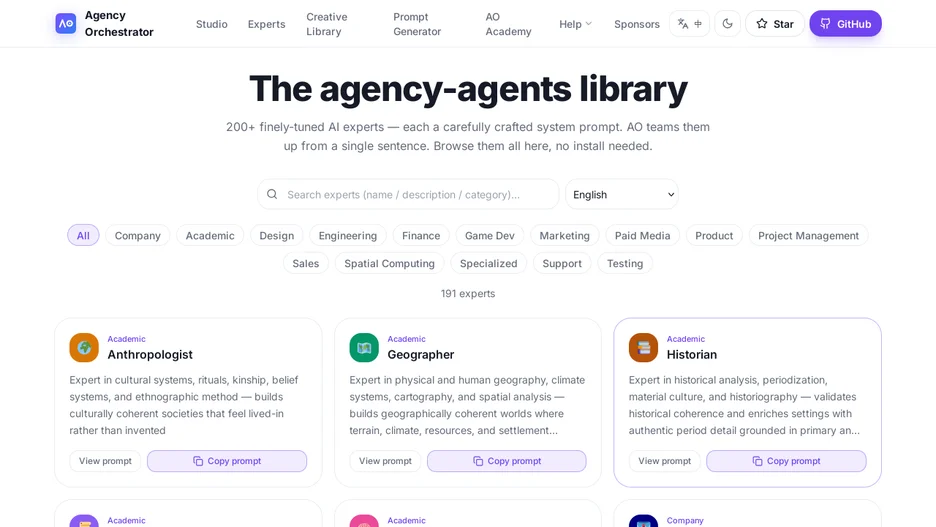
This is a Chinese-language edition of the agency-agents project: a set of 277 plug-and-play AI expert personas covering company roles such as CEO, CTO, CMO, COO, CPO and CFO, plus engineering, design, marketing, product, games, security, GIS and finance, across 20 departments. Each persona defines its own character, professional process and deliverables rather than a generic prompt template.
Beyond a full translation of the upstream project, this edition adds 64 personas built for the Chinese market, covering platforms such as Xiaohongshu, Douyin, WeChat, Feishu and DingTalk, along with cross-border e-commerce, government affairs, medical compliance, industrial Qt interfaces and mechanical design.
The personas work with more than 20 AI coding tools, including Claude Code, Cursor and Copilot, and can be run individually or coordinated automatically through the accompanying agency-orchestrator, which assigns tasks to multiple agents as a DAG. A native desktop client is also available for macOS, Windows and Linux.