

Agent S
An open-source computer-use agent that operates a real graphical interface, mouse, keyboard and screen, the way a person would, with successive versions reporting new state-of-the-art results on OSWorld.
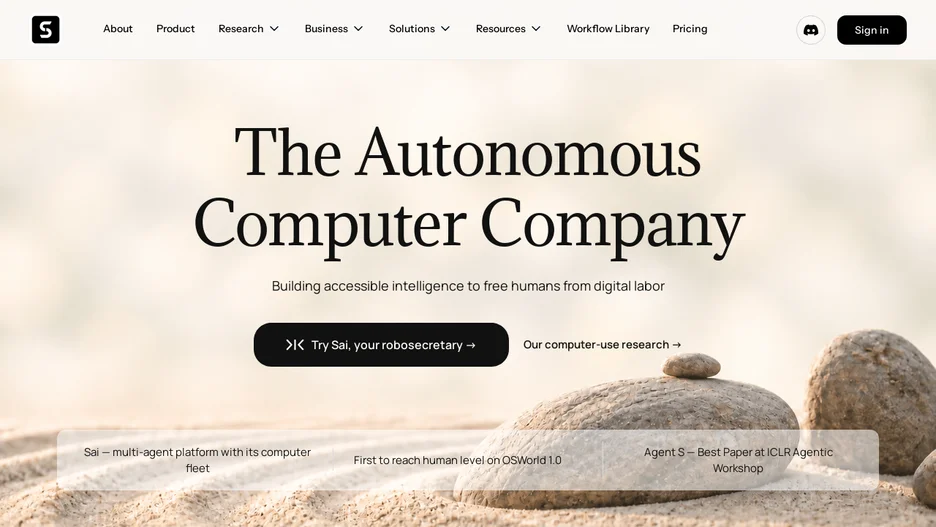
Agent S is an open-source computer-use agent that operates a real graphical interface, using the mouse, keyboard and screen the way a person does, rather than through an API built for automation. It has been developed across several published versions, from the original Agent S paper through Agent S2 and Agent S3 to a production agent called Sai, with each version's paper accepted at a machine-learning venue such as ICLR, COLM or TMLR.
Successive versions report new state-of-the-art results on OSWorld, a benchmark for computer-use agents: Agent S3 is reported as the first agent to exceed average human performance on OSWorld, and the production Sai agent is reported to top OSWorld 2.0 while costing less than comparable systems such as GPT- and Claude-based agents. Earlier versions also reported outperforming OpenAI's own computer-use agent and Anthropic's Claude Computer Use on the original OSWorld benchmark.
It is distributed as the gui-agents Python library, supporting macOS, Linux and Windows, with a hosted Simular Cloud offering to try it without local setup.