

agent-skill-manager
A scriptable CLI that installs, searches, audits and organizes AI agent skills across Claude Code, Codex, Cursor and 18 other tools, tracking token cost and letting a skill be read without installing it.
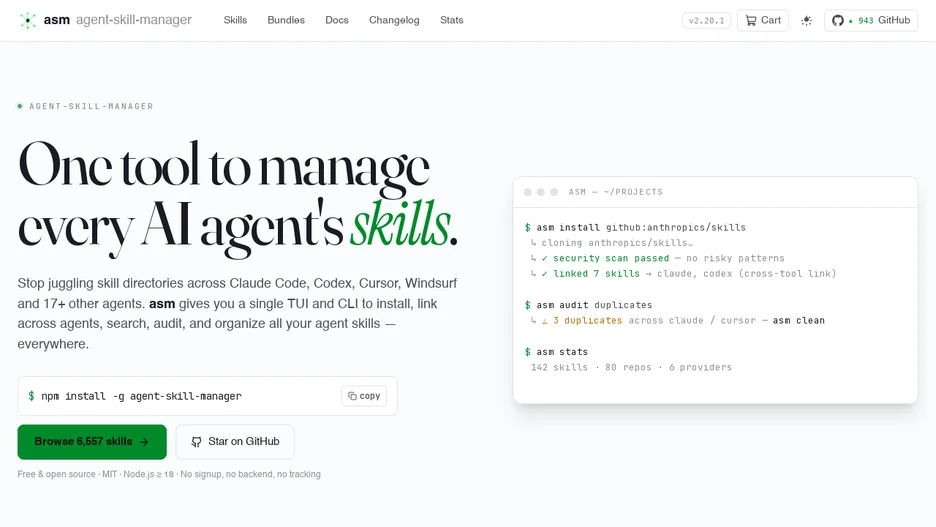
agent-skill-manager (asm) addresses skill sprawl across AI coding tools: the same skill copied with different versions into separate tool-specific directories, with no single inventory of what is installed, duplicated or outdated. Every command supports --json and --yes for non-interactive, agent-driven use, and an optional terminal UI supports local browsing.
asm list gives one view across all 21 supported providers and scopes; asm search, asm inspect, asm stats and asm audit cover discovery and inventory; asm stats --tokens and asm audit residency measure the context-token cost of an installed skill's description being resident in every prompt whether or not it fires; and asm get prints a skill's body without installing it, for reading a skill once rather than keeping it resident forever. Installing with asm install validates a skill's frontmatter, scans for shell execution, network access and credential exposure, and pins the registry commit installed.
Its catalog covers 6,082 skills from 77 repositories, browsable online, and it is MIT licensed with no accounts or telemetry.