

Agent Skills for Synalinks
A single Agent Skill, in the shared SKILL.md format read by Claude Code, Codex, OpenCode and other agents, that teaches a coding agent to write idiomatic code against the Keras-inspired Synalinks framework instead of mixing in Keras, LangChain or DSPy syntax.
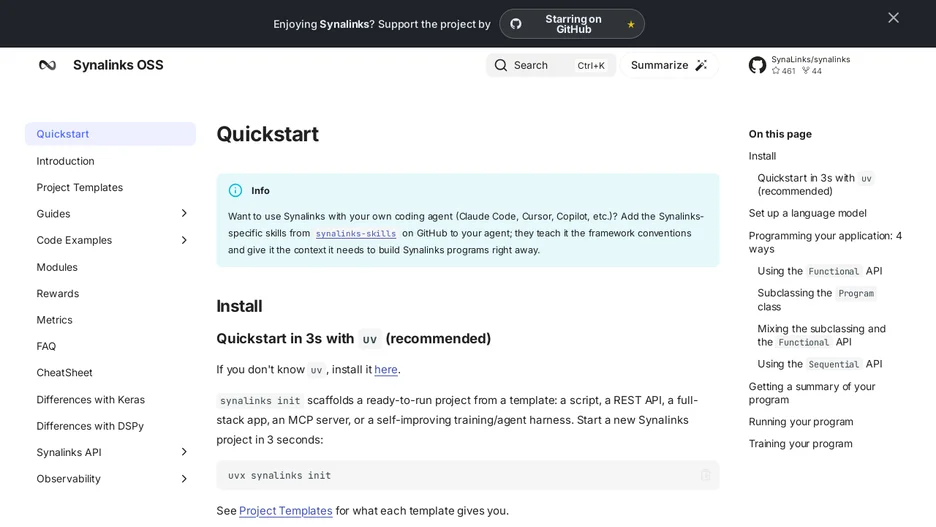
This repository ships one skill, synalinks, covering the whole Synalinks framework for coding agents that read the open Agent Skills SKILL.md format. Synalinks is Keras-inspired, and without this guidance a language model tends to mix Keras, LangChain and DSPy syntax, producing plausible-looking but broken code; the skill constrains an agent to idiomatic Synalinks usage instead.
The SKILL.md file is organized into one section per slice of the framework, each pointing to a runnable script with its captured run log and a deep-dive reference document: core data structures and operators, the Program class and its building APIs, reusable modules such as Generator and ChainOfThought, control-flow modules such as Decision and Branch, decision models, agent types such as FunctionCallingAgent and DeepAgent with MCP integration, a DuckDB-backed knowledge base with retrieval-augmented and knowledge-augmented generation, and a Keras-style compile, fit, evaluate and predict training loop.
An agent auto-activates the skill based on its SKILL.md description.