

AgentArea
A self-hosted platform for running an organization of AI agents that have defined roles, hand work to each other, and answer to policies over which tools they may call, what they may spend, and what a person must approve first.
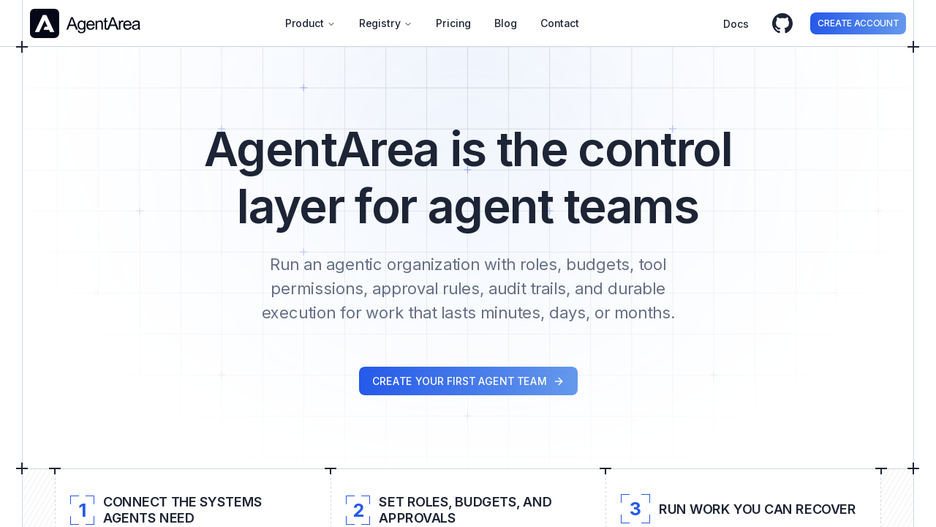
AgentArea runs every task as a durable Temporal workflow, so a crash or a mid-task deploy does not lose work and the run resumes where it stopped, and every model call and tool call passes a policy gate that allows it, denies it, or holds the run until a named person approves, without holding resources open while it waits. Commands run in sandboxes, credentials are resolved on the server rather than handed to agents directly, and access is modeled as a relationship graph that fails closed, with a record kept of who started what, which call was allowed or denied, who approved it, and what it cost.
A quickstart installer downloads a runtime bundle and generates credentials without cloning the repository, after which the stack is managed with plain Docker Compose; a walkthrough has a user add a model provider key, create an agent with a tool, mark that tool as requiring approval under a policy, and then start a task that pauses until the tool call is approved from an inbox. A Helm chart is provided for running it on Kubernetes.
It is written in Python and released under the Apache-2.0 license.