

Agentic Architectures
A Python library and runnable textbook packaging 35 production-grade agentic AI patterns, such as Reflexion, LATS, GraphRAG and MemGPT, each with an executed notebook, multi-provider support and a shared benchmark leaderboard.
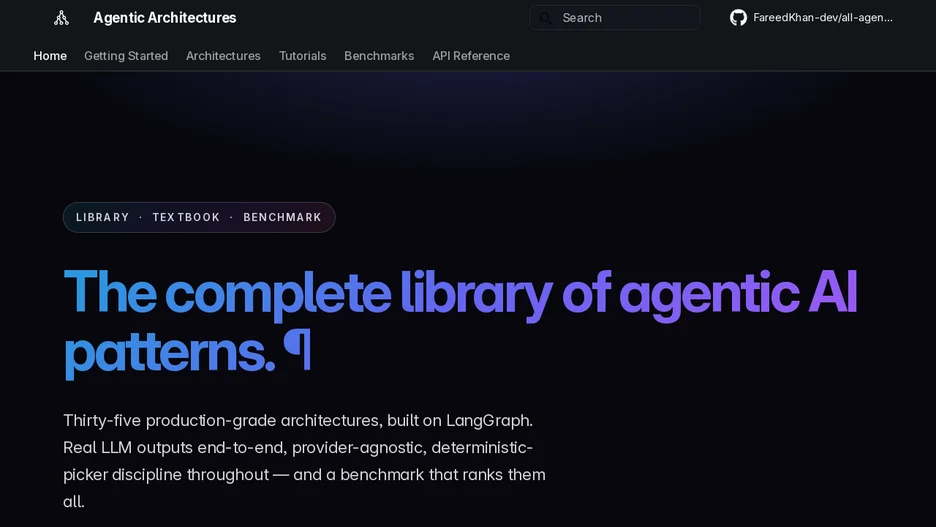
Agentic Architectures packages 35 major agentic AI patterns from the research literature as a single Python library, with each pattern implemented as a runnable Architecture class sharing one uniform run and result interface. Every pattern ships with a fully executed Jupyter notebook whose explanation is written against the captured run rather than a synthetic example, and the library works across nine LLM providers, built on top of LangGraph state machines.
A central design discipline, used in 13 of the 35 architectures, has the language model commit to categorical features such as booleans or enums and lets ordinary code compose the deciding signal, avoiding a common failure mode where an LLM used as a scorer collapses toward a narrow band of scores. The patterns are grouped into families such as reasoning and reflection, sampling and search, retrieval-augmented generation, and memory, and are ranked against each other on a 17-task benchmark leaderboard.