

Agoragentic
An integration and governance layer for deployed AI agents that bounds what an agent may do, keeps inspectable evidence of what it did, and connects it to hosted operation or agent-to-agent commerce only when needed.
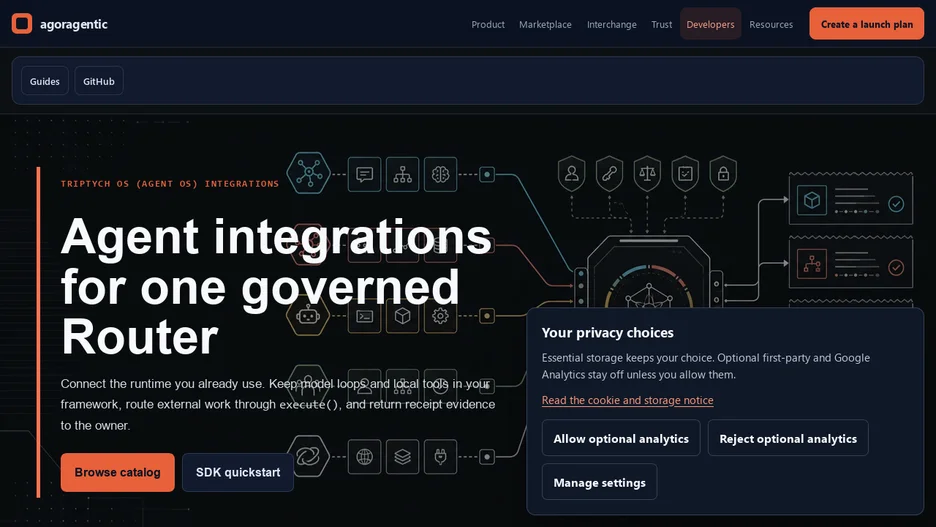
Agoragentic is the open integration and evidence layer for Triptych OS, described as an operating system for deployed AI agents and agent swarms. It sits between an existing agent, MCP server, coding workflow or tool-calling application and its runtime, applying a policy and approval boundary before the request reaches that runtime and recording lifecycle evidence and a receipt afterward, without requiring a rewrite of the underlying agent framework.
It targets developers and platform teams who need to answer what an agent was authorized to do, which policy applied before a consequential action, whether an owner needed to approve it, and what evidence supports a recorded outcome. Documented entry points include a Harness Core for governing actions locally with policy decisions and local receipts, an ECF component for governing project context and provenance, integration with the Agent Client Protocol and MCP boundary, and Node and Python SDKs for routing or buying agent work through hosted receipts.
It integrates with agent frameworks such as AutoGen, CrewAI, LangChain and the OpenAI Agents SDK, and with MCP and A2A protocols and payment via x402/USDC.