

AI Agents Framework
A Rust framework that builds an AI agent from a single declarative YAML specification, covering state machines, layered tool policy, twelve LLM providers with fallback, and a memory stack, with no code required for common cases.
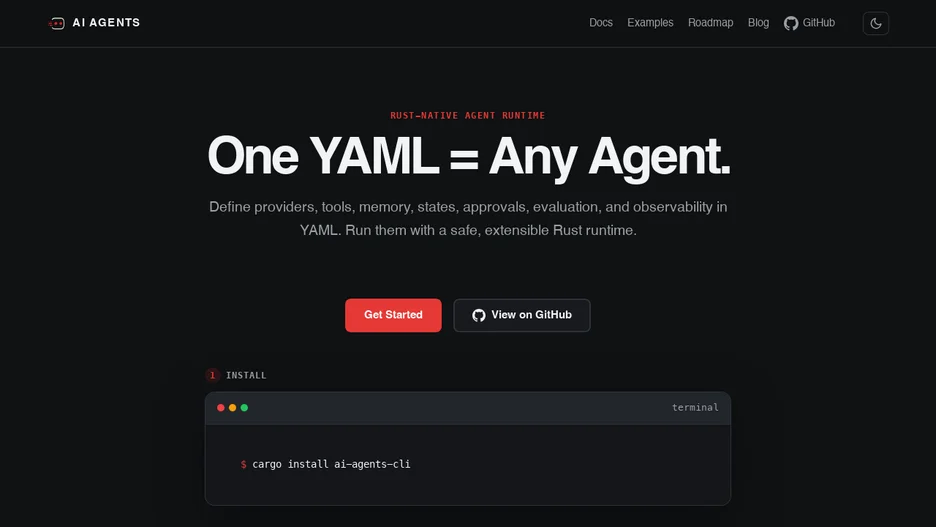
This framework describes an agent's behavior declaratively in YAML rather than in code for common cases, while still allowing Rust host integrations for custom extensions. An agent is a hierarchical state machine whose transitions are evaluated by the LLM against guards, with entry and exit actions and reusable multi-step skills, and layered overrides that cascade from global settings down through agent, state, skill and turn level.
It supports twelve LLM providers, including OpenAI, Anthropic, Google, Ollama, DeepSeek, Groq, Mistral, Cohere, xAI, Phind and OpenRouter, with named aliases and automatic fallback on failure, and thirty canonical built-in tools covering the filesystem, git status and diff, web fetch and search, and shell commands, alongside Model Context Protocol integration for hundreds more. Safety controls include fail-closed tool grants, explicit top-level and state-level tool scoping, review modes for filesystem mutation, command allowlists and atomic rate admission, and a memory stack spans compacting in-context memory with token budgeting plus file, Redis or SQLite-backed persistence across sessions.