

ai·rete·rag
A platform that pairs a Rete rule engine with retrieval-augmented generation, so deterministic rules decide an outcome and grounded retrieval explains the decision in plain language.
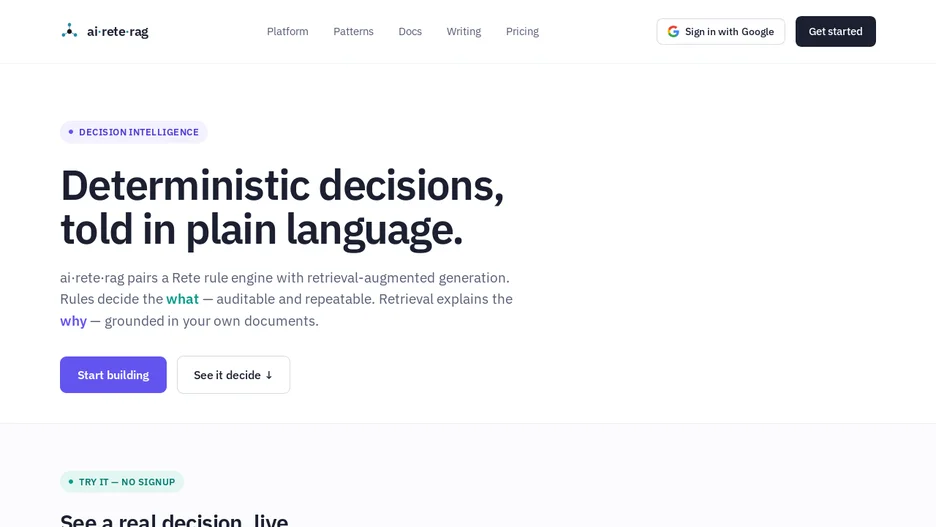
ai·rete·rag combines a Rete rule engine with retrieval-augmented generation. Rules make the underlying decision in an auditable, repeatable way, while retrieval over the user's own documents supplies a plain-language explanation grounded in evidence, addressing the usual trade-off in which rule engines are precise but cannot explain themselves and language models explain well but are not reliably exact.
The platform wires rules and retrieval together three ways: rules can narrow what gets retrieved, for example limiting a cardiac case to cardiology sources; retrieved documents can be parsed into facts that are asserted into the session for rules to act on; or a rule fires first and retrieval is invoked only afterward to produce a human-readable explanation of the trace.
It ships with eight built-in decision domains, including loan underwriting, fraud screening, and clinical vitals, and lets a user bring their own rules and policies to build additional ones. Every decision links back to the exact rules that produced it.