

ARES
A self-healing multi-agent runtime, built in Go, that treats agents as autonomous cognitive processes rather than functions called by a central orchestrator.
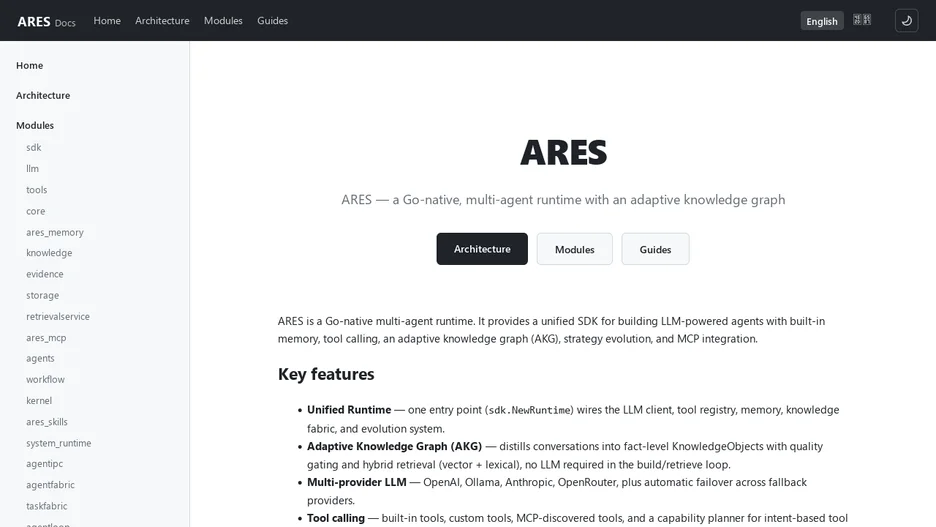
ARES describes itself as an Agent Operating System: a kernel providing scheduling, synchronization, IPC, resource enforcement, lifecycle management and recovery for agents that independently create work, communicate as peers, keep private cognitive state and may spawn other agents. Tasks are durable and outlive the process executing them through lease and epoch fencing, checkpointing and event-sourced recovery, with execution run in cooperative steps of reason, tool, observe, checkpoint and yield, and scheduling policies covering capability matching, load, confidence and priority able to change in production without restarts.
It ships a unified SDK that can assemble an entire runtime, including its LLM, memory, distillation, evolution and tool configuration, from one YAML file, along with a DAG workflow engine, chaos engineering, and MCP support, plus a CLI.
An included Adaptive Knowledge Graph feature is explicitly marked beta and experimental: it builds relations with rule-based regex extraction and hybrid BM25 and vector search rather than an LLM, and the project states its API may still change and it is not production-ready.