

Atomic Agent
A local-first AI agent that runs its control loop and all state on the user's own machine, driving the browser, editing files, running approved shell commands and remembering context across sessions, using small local models through llama.cpp or a cloud model.
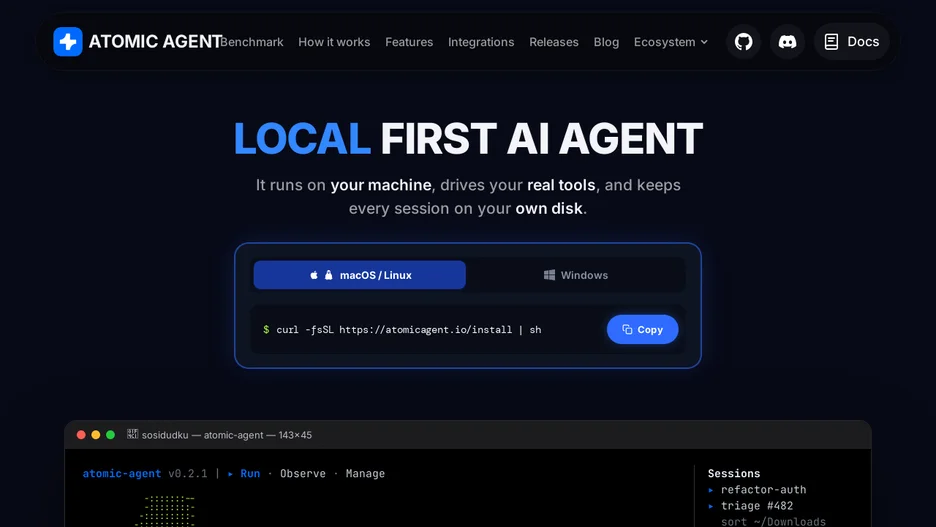
Atomic Agent is a local-first AI agent: its control loop and all state run on the user's machine rather than a hosted service. It can drive a desktop browser, read and edit files, run shell commands that have been approved, inspect documents, remember context across sessions, schedule follow-up work, and call external tools over MCP, and it can be embedded in another application over HTTP or as a Tauri sidecar.
It runs on llama.cpp by default, with an optimized build the project reports gives 30 to 50 percent more throughput on small local models, so quantized models remain usable for long, multi-step tasks on ordinary consumer hardware; cloud models can also be used.
It installs as a single binary with a command-line interface and a terminal UI, updates itself in place, and can import skills, memory, MCP servers, sessions, scheduled jobs and, optionally, provider keys from other agents such as Hermes, OpenClaw, Claude Code, Codex, Pi or Oh-My-Pi, previewing the import before anything is written. It is a developer preview, and its APIs, commands and behavior are still changing.