

Autono
A ReAct-based autonomous agent framework that dynamically generates its next action from prior trajectories instead of a fixed planner-generated workflow, with a probabilistic abandonment strategy and a shared memory-transfer mechanism for multi-agent collaboration.
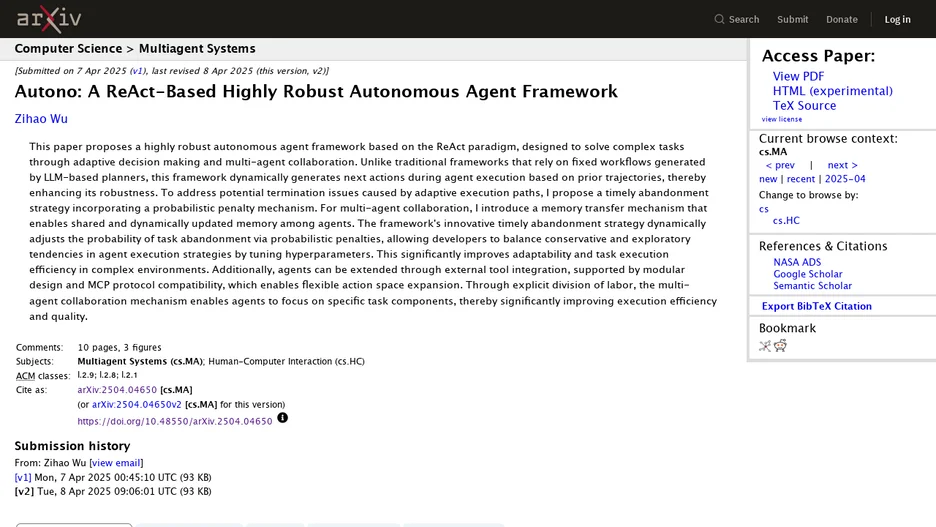
Autono implements the ReAct paradigm with an emphasis on robustness: rather than relying on a fixed workflow generated upfront by an LLM planner, it dynamically decides its next action during execution based on the trajectory so far, which the project argues improves robustness on tasks where the plan may need to change. A timely-abandonment strategy uses a tunable probabilistic penalty to decide when to give up on a stalled path, letting a developer balance conservative against exploratory behavior through hyperparameters, and a memory-transfer mechanism lets multiple agents share and dynamically update memory during collaboration.
Agents can be extended with external tools through a modular design and Model Context Protocol compatibility. The project's own benchmark compares Autono against two other popular agent frameworks on one-step, multi-step, and multi-step-with-possible-failure tasks across several models, reporting higher success rates for Autono, particularly on multi-step tasks with injected failures.
It is a Python framework released under the GPL-3.0 license, documented in English, Traditional Chinese, Simplified Chinese, and Japanese.