

awesome-agentic-ai-zh
A trilingual (Traditional Chinese, English, Simplified Chinese) learning roadmap for agentic AI, with more than 240 curated resources and hands-on exercises from LLM basics to multi-agent systems.
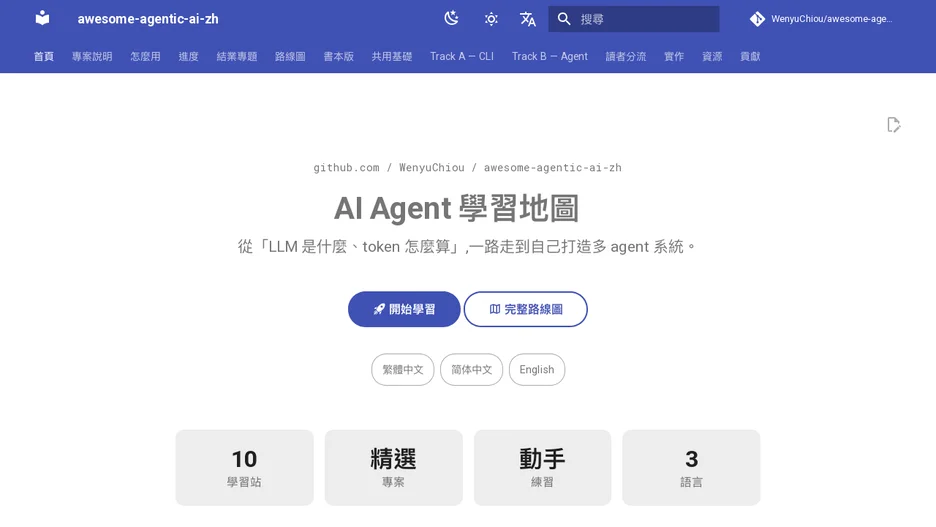
awesome-agentic-ai-zh is a learning roadmap that takes a reader from "what is an AI agent" to being able to build a reliable agent system, defining an agent as an AI system that judges its next step and takes action toward a goal a person sets, using tools when needed and continuing, correcting, stopping, or handing control back to the person as results come in. It is organized as a route plus curated resources plus runnable small exercises, pointing to official documentation, an existing Chinese-language resource, or matching cookbooks for full chapters rather than duplicating them.
The material spans eight main stages plus a Stage 0 foundations section and a further-reading stage, with two tracks after shared foundational stages: Track A for CLI power users who want to get work done with tools such as Claude Code, Codex or OpenCode, covering picking a CLI agent, building repeatable workflows, and the Claude Code ecosystem of MCP, Skills, plugins, hooks and subagents; and Track B for readers who want to build an agent from scratch, starting from tool use and a first agent loop.
A separate guide serves readers who only want to use AI safely day to day without writing code.