

AX
An early-stage, declarative orchestration runtime from Google for running billions of autonomous agent workloads across a cluster, sandboxing each task on top of a separate 'Agent Substrate' layer.
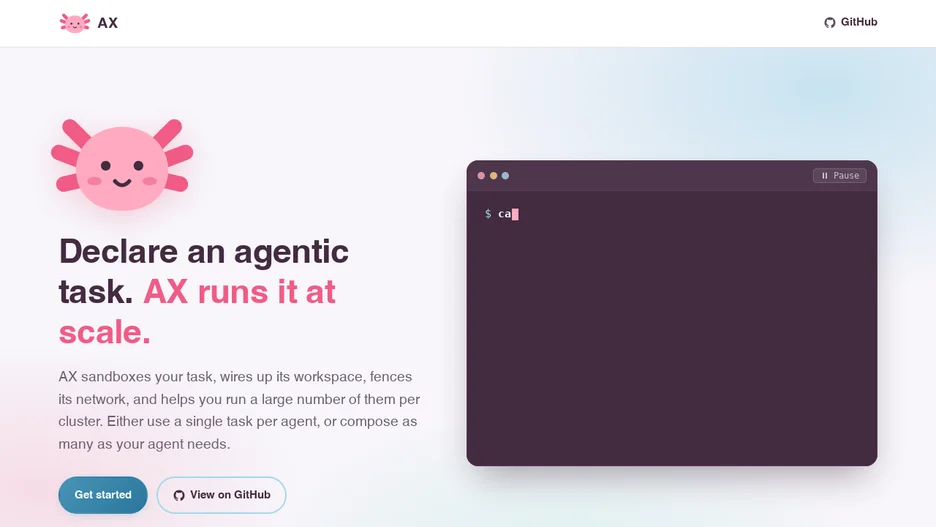
AX is a high-throughput, declarative orchestrator from Google for running autonomous agent workloads at scale across a cluster, comparable in feel to Kubernetes: a task is declared with its workspace and model specification, and AX sandboxes it, wires up its workspace and helps run it, with support for looking over a running agent's shoulder as it works. It runs on top of a separate layer called Agent Substrate for sandboxed execution, and is built to handle billions of tasks per cluster.
It expresses agent workloads through three primitives: a Task runs untrusted agent code in an isolated sandbox with CPU and memory limits, a Workspace pre-wires the Git repositories, MCP servers and skill packages an agent needs so every run starts warm, and a Model configures which large language model the platform itself uses, with credentials sourced from a Kubernetes secret. Idle agents can be paused and resumed from exactly where they left off, and a running agent can be reached directly over a shell-like connection to see what it is doing.
The project is explicitly early-stage, and expects major breaking changes before a stable release.