

Build Your Own OpenClaw
An 18-step, hands-on tutorial that walks through building a minimal AI agent from a simple chat loop up to an event-driven, multi-agent system with scheduling and long-term memory.
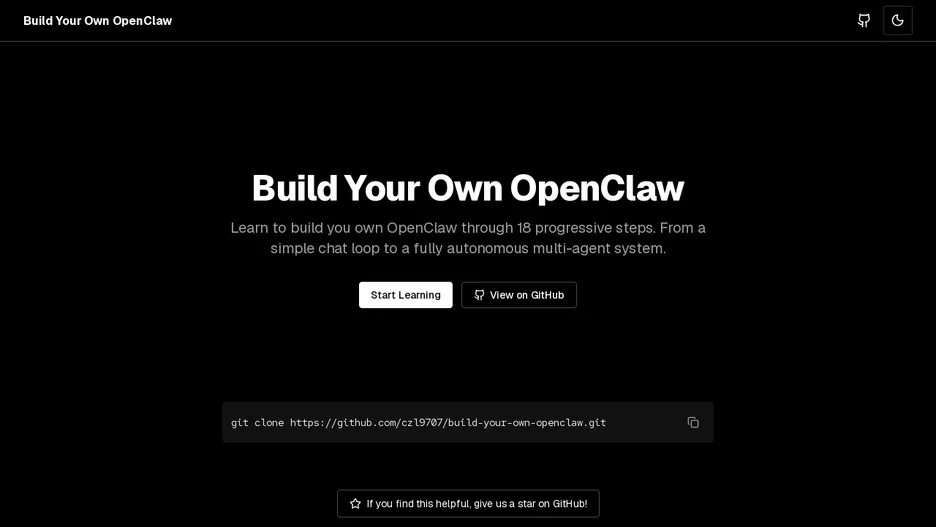
Build Your Own OpenClaw is a step-by-step tutorial for building a minimal AI agent in 18 progressive steps, each with a README explaining its key components and design decisions plus a runnable codebase, using a reference implementation called pickle-bot.
Phase one builds a single capable agent that can chat, use tools, learn skills defined in SKILL.md, persist conversations, accept slash commands and browse the web. Phase two refactors the agent to an event-driven architecture with hot-reloadable configuration and multi-platform channels, including a WebSocket interface. Phase three adds multi-agent routing, a cron-driven heartbeat for scheduled work, multi-layer prompts, the ability for the agent to message the user first, and dispatching work to other agents. Phase four adds concurrency control and long-term memory.
Model access is configured through LiteLLM, so a user can plug in any supported provider.