

Cersei
A Rust SDK that provides every building block of a production coding agent, tool execution, LLM streaming, sub-agent orchestration, persistent memory, skills and MCP integration, as composable library functions rather than a fixed CLI app.
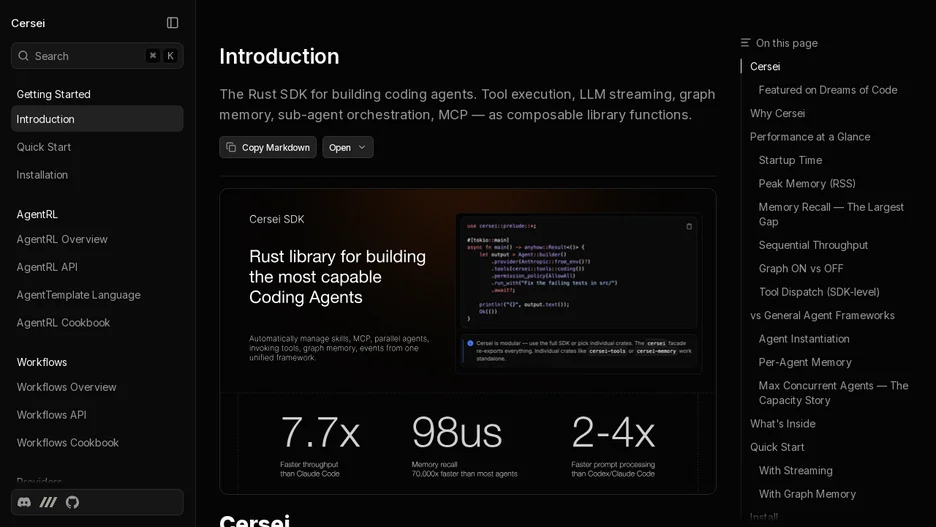
Cersei exposes an Agent::builder() API that composes a model provider, a set of tools, a permission policy and a prompt into a single asynchronous call, so an agent can be embedded directly in another application rather than run only as a standalone CLI. It supports multiple providers, unlike a single-provider agent, and stores memory as files plus a graph rather than only flat files or only SQLite.
Abstract, a companion CLI built on Cersei, ships as one binary with zero runtime dependencies and graph memory by default, and its benchmark against Claude Code reports an 8.2 times faster warm startup (32ms versus 266ms), a binary about 29 times smaller (6.0MB versus 174MB) and around 68 times less resident memory (4.9MB versus 333MB). It installs with cargo install --path crates/abstract-cli and supports an interactive REPL, a single-shot prompt, session resume, an Opus-with-max-thinking mode, and a JSON, no-permissions CI mode.
It reads its own tool and skill formats as well as those used by Claude Code and OpenCode. It is released under the MIT License.