

Chamber
An Electron desktop workspace for creating, running and coordinating AI agents ('minds') powered by GitHub Copilot, built around Agent-to-Agent collaboration: minds discover each other, message each other, delegate stateful tasks and hand off artifacts.
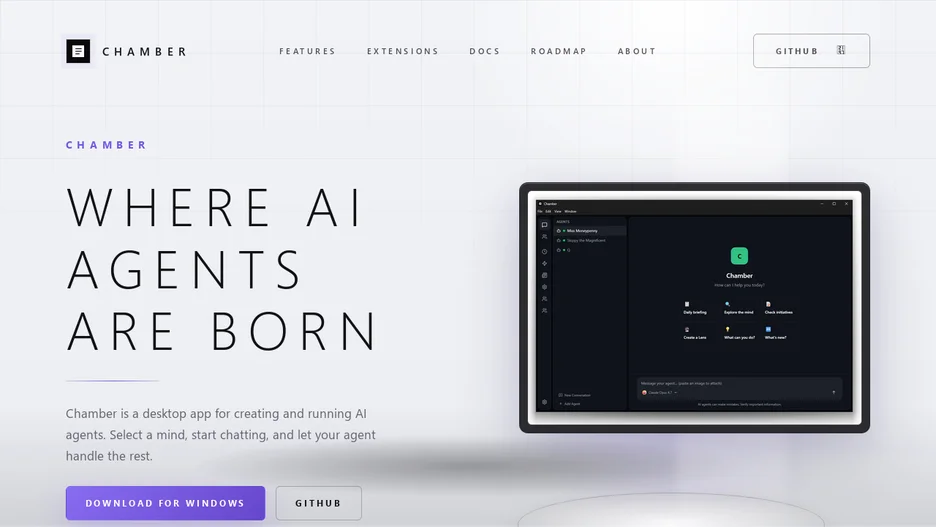
Chamber is a desktop application, built with Electron, for running several AI agents together rather than treating chat as the whole interface. Each agent, called a mind, has its own identity, memory, tools, scheduled work and UI that can grow with the tasks it is given, and minds are built around Agent-to-Agent collaboration: they expose Agent Card-style metadata describing their skills so other minds can discover what they do, send each other direct messages, create stateful tasks that can be tracked, checked on or canceled, and share context across a conversation through a shared context ID, with task results becoming artifacts another mind can review or build on.
Beyond chat, Chamber provides Lens views, Canvas pages, tables, timelines, forms and status boards as practical desktop tools, plus built-in cron jobs, conversation history, model selection and desktop notifications, and marketplace-installed minds extend what is available. Multiple minds can collaborate in a chatroom under concurrent, sequential, moderated, handoff or manager-led modes.
It downloads as a Windows desktop application and is powered by GitHub Copilot for its underlying model access.