

Claude Code Templates
A CLI and web catalog of ready-to-use Claude Code configurations, including agents, slash commands, MCP integrations, settings, hooks and skills, plus tools for monitoring and diagnosing a Claude Code installation.
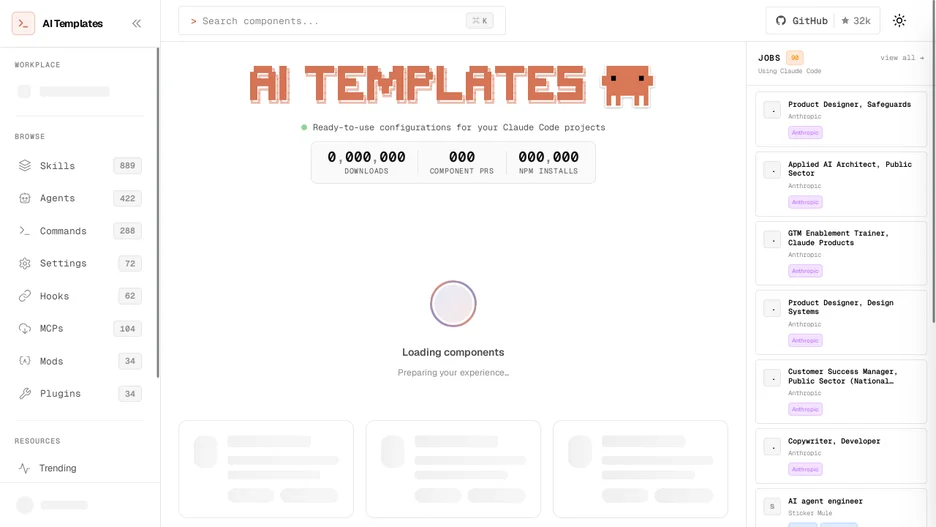
The npx claude-code-templates command browses and installs from a catalog of more than 100 components, including domain-specialist agents such as a security auditor, a React performance optimizer or a database architect, custom slash commands, MCP integrations with services such as GitHub, PostgreSQL, Stripe and AWS, Claude Code settings, automation hooks, and reusable skills. A companion web interface lets a user browse and install the same catalog interactively.
Beyond the template catalog, the CLI adds an analytics mode that monitors Claude Code sessions in real time, a mobile-optimized conversation monitor for viewing responses remotely, optionally over a Cloudflare Tunnel, a health-check diagnostic for a Claude Code installation, and a plugin dashboard for viewing marketplaces and installed plugins. Its component catalog includes contributions from other projects, such as Anthropic's own official skills, a scientific-skills collection for biology, chemistry and medicine, and community workflow skills.
It is written in Python and licensed under the MIT license.