

Collaborative Human-Agent Protocol (CHAP)
An open, MCP- and A2A-compatible protocol and runtime for auditable human-agent work, giving approvals, overrides, handoffs and escalations one shared, hash-chained shape that can be queried instead of grepped from logs.
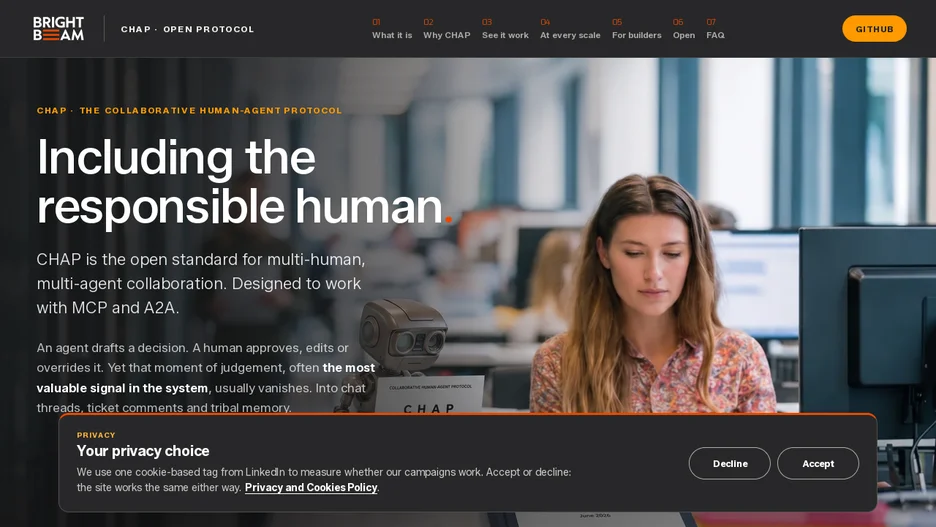
CHAP is a runtime and protocol for recording accountable decisions between humans and AI agents. When an agent drafts something, such as a code review comment or a contract redline, and a human approves, edits or rejects it, CHAP stores that exchange as a structured artefact and override, with a diff, a rationale and tags, chained together by content hash so the whole history can be fetched with one call instead of reconstructed from chat threads and logs.
An optional signed profile adds an Ed25519 signature to every envelope, bindable to a real identity through an OpenID Connect profile, and another profile anchors the hash chain in an external transparency log that can be verified without trusting the operator's own servers. CHAP is designed to sit alongside the Model Context Protocol and the Agent2Agent protocol rather than replace them: MCP for tools, A2A for other agents, and CHAP for the shared record of human-agent work.
An embedded coordinator can persist to SQLite, and both TypeScript and Python surfaces are provided, including a typed facade in TypeScript.