

ConnectOnion
A CLI harness that lets any agent that can run a shell command reach real services, such as Gmail, a persistent browser and messaging apps, without needing its own OAuth app or SDK per service.
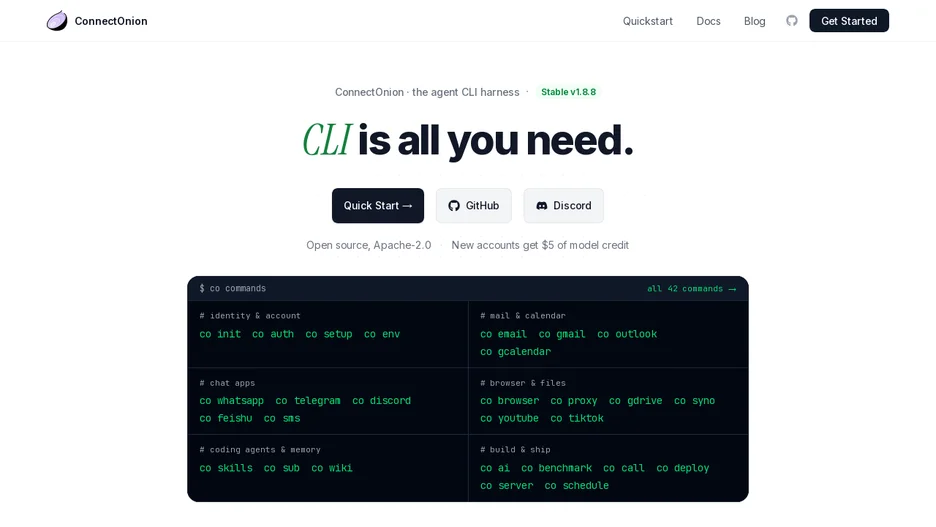
ConnectOnion gives an AI agent a set of command-line tools for reaching outside systems, so it does not need a separate OAuth app, DNS records or a custom script for every service it wants to use. Each capability is a co subcommand the agent runs in its shell, including identity and authentication, a persistent browser that stays logged in after a manual sign-in and 2FA, Gmail, Outlook and calendar access, and chat channels such as SMS, Telegram and WhatsApp.
Because the agent only needs to know the co command itself, which documents its own subcommands and hints at what to run next, its actions stay legible as a list of shell commands rather than opaque API calls. Google and Microsoft credentials are stored only on the user's own computer, and shell, file-write and email actions pause for approval when a chat UI is attached. It installs with pip install connectonion and is licensed Apache-2.0.