

CORAL
Infrastructure for autonomous AI agent organizations that run coding-agent experiments against a grader, share knowledge, and evolve across isolated workspaces, integrated with Claude Code, OpenCode, Codex, Cursor Agent and Kiro.
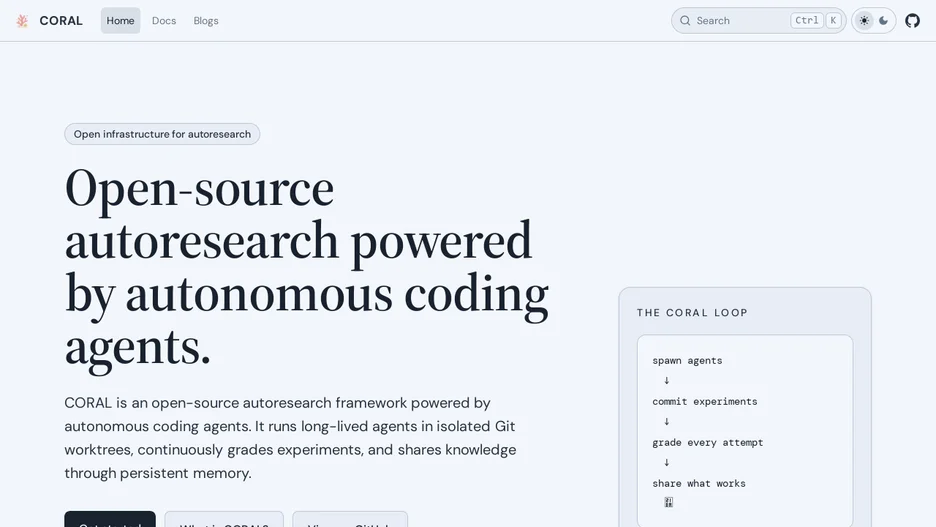
CORAL is infrastructure for autonomous AI agent organizations built for autoresearch: given a codebase and a grader, it manages isolated workspaces, safe evaluation, persistent shared state and multi-agent collaboration so agents can run experiments, share knowledge and continuously improve solutions. It integrates natively with Claude Code, OpenCode, Codex, Cursor Agent and Kiro.
A Docker session isolates each agent from the grading process: every agent runs as an unprivileged user while the manager and grader stay root, so agents cannot read the grader's private answer keys even through a shell. Multi-island runs partition agents into isolated islands with their own scoped attempts, notes, skills and heartbeat state, with migration between islands for broader exploration, and reusable rubric-judge grader packages support open-ended tasks such as reports or legal analysis.
It installs globally through a shell script, or through a plugin that lets a user's own Claude Code or Codex session author and run CORAL tasks without memorizing its CLI.