

CoWorker Protocol
A peer-to-peer protocol that lets someone serve a private AI skill as a callable remote function over an encrypted channel, so a caller receives only the result and never the underlying prompt, code, or methodology.
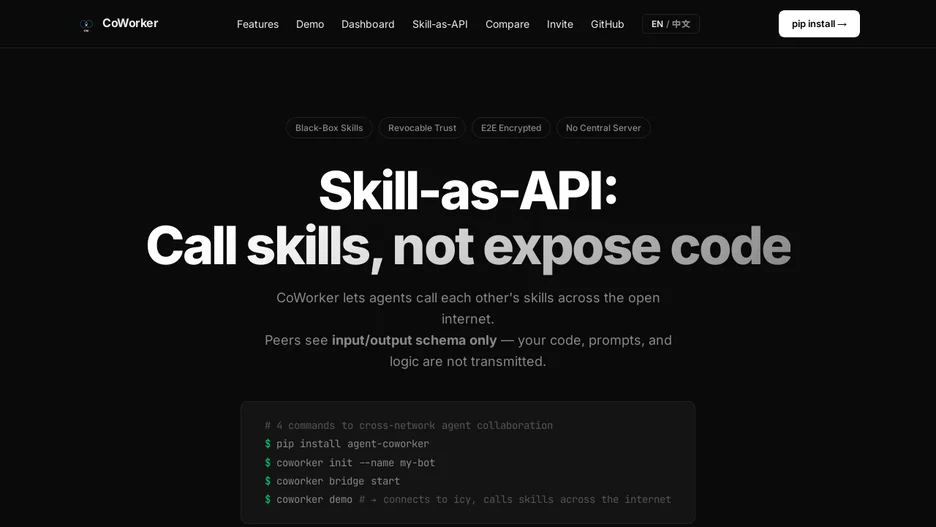
CoWorker Protocol turns a Markdown skill file into a callable remote API that runs on the skill owner's own machine: a caller invokes the skill and receives the computed result, but the prompt, code, and methodology behind it are never transmitted anywhere, addressing the problem that a plain text skill file can otherwise simply be copied by anyone who can open it. It uses end-to-end encryption over the XMTP messaging protocol and a four-level trust model of untrusted, known, internal, and privileged callers that the skill owner controls.
Access can automatically downgrade once a defined objective is complete rather than staying open indefinitely, and a hidden skill reports as unknown to a caller who is not authorized to see it exists at all. Because the caller's request reaches a function interface rather than the owner's language model directly, the protocol also narrows prompt-injection risk down to whatever that function's return value exposes, and reusable, non-expiring invite codes let an owner share access to a running skill through any channel.