

DotCraft
An open-source, self-hosted AI agent runtime built on .NET that runs as a desktop app or embeds into a .NET application, extensible with plugins and controllable remotely from a CLI, IDEs, or chat bots.
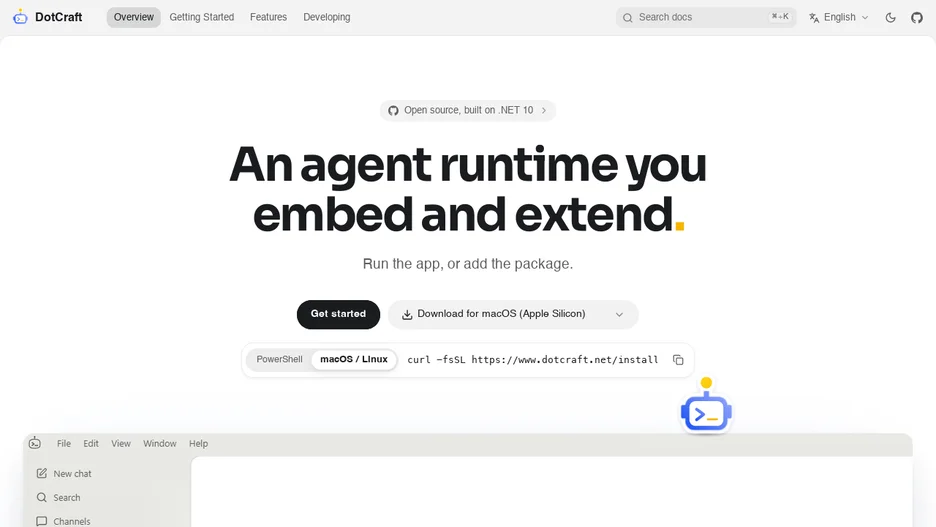
DotCraft is an open-source, self-hosted AI agent runtime built with C# and .NET. It runs as a desktop app, embeds into an existing .NET application, and can be extended by both host applications and plugins.
Built-in features include planning, subagents, automations, goals, dynamic workflows, an in-app browser, and an agent builder that turns a description into a reusable agent. With computer-use support, agents can operate the Windows applications a user allows. Desktop, CLI, IDEs, and chat bots share one workspace, and DotCraft can connect to a server over SSH or hand off work to another computer. It supports OpenAI and Anthropic model providers, or signing in with a ChatGPT subscription, and a shared model service lets one machine hold API keys and credentials for a team's other machines.
.NET plugins add tools, commands, and lifecycle logic, and can be swapped in while the host keeps running; separate plugins reshape the desktop interface. Companion components cover an embeddable runtime, task management, remote execution, and agent personas.