

dstack
A unified control plane for provisioning and orchestrating GPU compute across clouds, Kubernetes, VMs and bare-metal clusters, used to run AI training and inference on NVIDIA, AMD, Google TPU or Tenstorrent hardware.
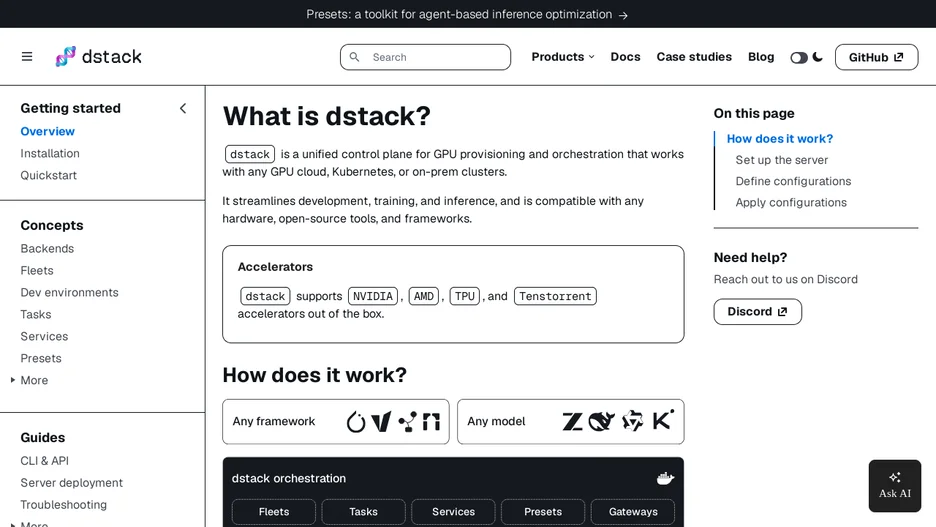
dstack is a control plane for GPU provisioning and orchestration that works uniformly across GPU clouds, Kubernetes clusters, on-premises servers, and bare metal. It standardizes how to configure backends, launch a server, and submit training or inference workloads without hand-writing infrastructure for each target.
It supports NVIDIA, AMD, Google TPU and Tenstorrent accelerators, and recent releases have added Slurm and Kubernetes backends, multi-cluster support, replica groups and gateway replicas, and experimental agent-driven inference optimization presets. On-premises use needs no backend configuration: SSH fleets can be created directly once the server is running.
The server installs on Linux, macOS or Windows via WSL2 and requires Git and OpenSSH; a separate lightweight CLI can be installed on its own to talk to an existing server. Installable agent skills also let AI coding agents such as Claude, Codex and Cursor create fleets and submit workloads on the user's behalf. It is written in Python and licensed under MPL-2.0.