

E.D.D.I — Multi-Agent Orchestration Middleware for Conversational AI
A config-driven, multi-agent orchestration middleware for conversational AI that routes between more than a dozen LLM providers, coordinates business systems through APIs, and supports the MCP and Agent-to-Agent protocols with persistent memory.
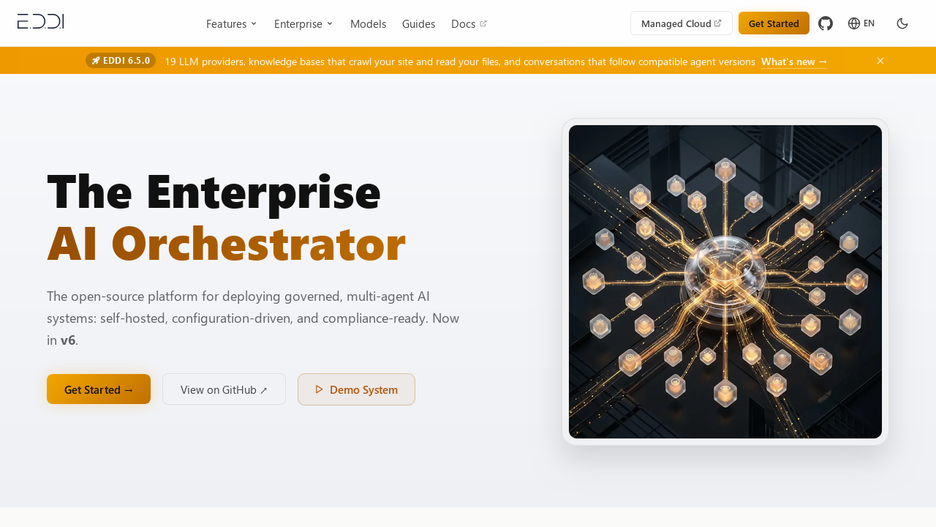
E.D.D.I (Enhanced Dialog Driven Interface) is a production-grade, config-driven multi-agent orchestration middleware for conversational AI. It coordinates users, AI agents, and business systems through intelligent routing, persistent memory, and API orchestration without requiring custom code, and supports more than a dozen LLM providers alongside the Model Context Protocol, Agent-to-Agent protocol, Slack, OpenAPI, and OAuth 2.0.
A one-command installer sets up EDDI with a chosen database through Docker Compose and opens a dashboard where an operator role, or a form-based agent wizard, creates the first AI agent. Installer options add a specific database and authentication, or enable monitoring, and a CLI wrapper handles updates by pulling the latest image and restarting containers.
It is built with Java and Quarkus, ships as a certified Docker image, and documents compliance considerations for the EU AI Act, GDPR, and HIPAA. It is licensed under Apache-2.0.