

Elixir Phoenix Plugin for Claude Code
A Claude Code plugin with 26 specialist agents and enforced coding rules for Elixir, Phoenix and LiveView projects, planning, implementing, reviewing and verifying changes in parallel and integrating with the Tidewave MCP server.
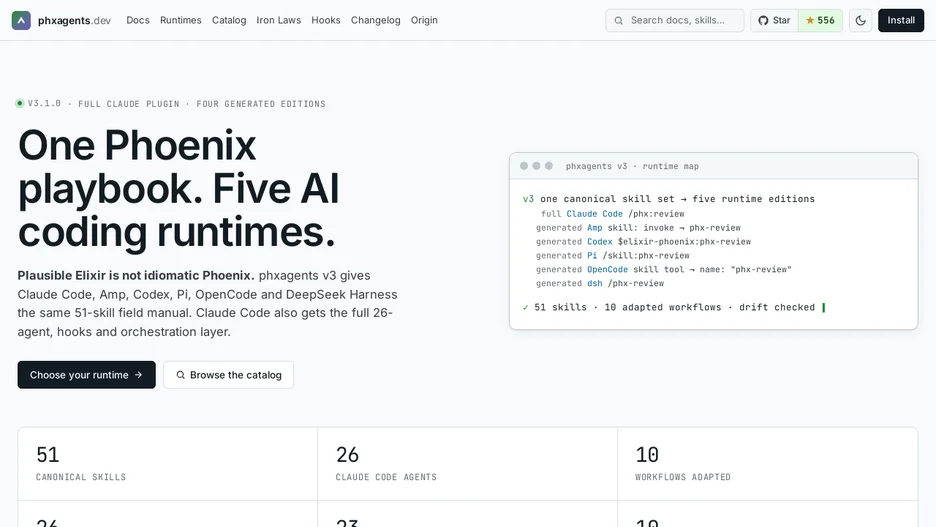
This plugin coordinates 26 specialist agents that plan, implement, review and verify Elixir and Phoenix code in parallel, each with its own domain expertise, fresh context, and a set of enforced coding rules meant to catch bugs that automated tests would miss, such as a helper that silently skips work on reconnect, a numeric type that can corrupt monetary fields, or a background job that is not written to be safely retried. Reviews run as four-agent parallel audits, and learnings are captured as reusable knowledge.
It integrates with Tidewave, an MCP server for Elixir and Phoenix projects, and is available across several coding-agent hosts beyond Claude Code: a generated edition for Amp with the same skills and agents, a native skills plugin for Codex with a trust-gated safeguard for destructive commands, a skills package for the Pi coding agent, and a skills-only target for OpenCode and for DeepSeek Harness; the exact set of included agents, hooks and MCP registration differs by host, and installation and version-compatibility details are documented on the project's own site.