

espalier-engineering
A Claude Code plugin that discovers a codebase's actual conventions and encodes them as rules, skills, sub-agents and enforcement hooks, so generated code follows those conventions from the first attempt.
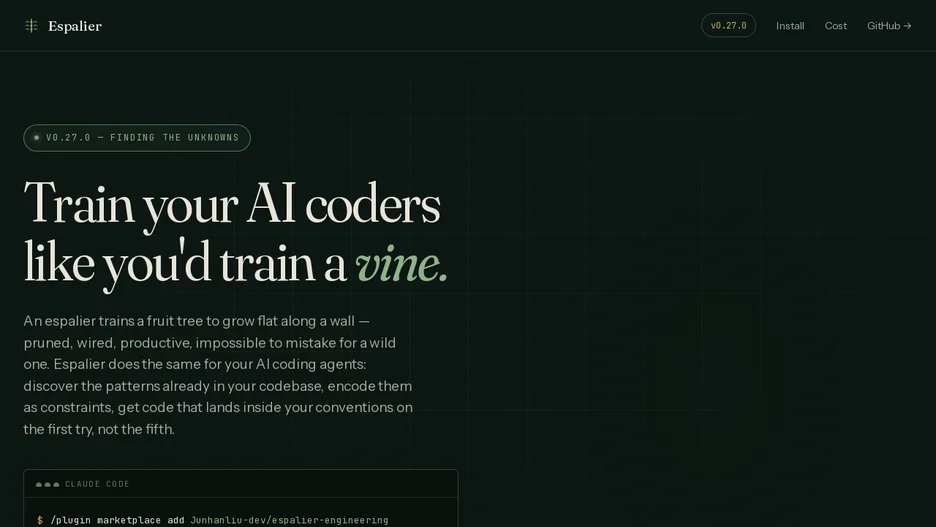
espalier-engineering reads an existing codebase, discovers the conventions already in it, and writes them down as a per-project directory of always-loaded rules, phase-loaded skills, sub-agent definitions, a wiki and programmatic hooks, so an AI coding agent's output fits the project's actual patterns instead of generic choices.
A one-time init command runs parallel scout agents to extract those unwritten conventions; after that, every change goes through a ten-stage pipeline where a coder agent writes the change, a separate reviewer agent with a different tool set checks it against the same rules, and hooks block a push that skips the gates. A drift-detection step flags documentation the code has since outgrown for review rather than letting it go silently stale.
It installs as a Claude Code plugin marketplace entry, with commands for a slimmer bug-fix lane, read-only question answering sourced from the project's own docs, a repository-wide security audit, a simplification survey and larger multi-session planning.