

FastAgent
A serving runtime that takes an existing file-defined agent directory and runs it as a live service, embedded in a web app, deployed as a Telegram, Slack or Feishu bot, or exposed as an API endpoint.
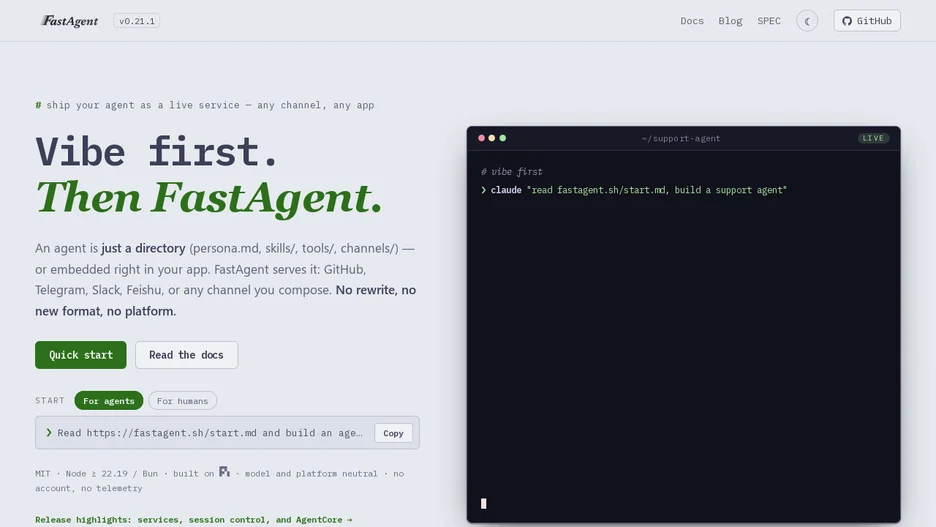
FastAgent does not introduce a new agent-authoring format; a developer brings an existing agent directory, with its markdown instructions, reusable skills and TypeScript tools kept as ordinary files, and FastAgent provides the serving runtime and channel adapters around it. It can serve the same agent as a Telegram, Slack, Feishu or Lark bot, a verified webhook handler, or a streaming HTTP/SSE endpoint, or be mounted directly as one route inside a Next.js, Astro, Hono, Bun or Node application using the developer's own authentication, database and infrastructure.
Any model provider, including OpenAI, Anthropic or Google, can be used through OAuth or an API key, with typed tools discovered automatically from a tools folder and validated with Zod, and Agent Skills loaded on demand. Deployment targets, generated by a single command, include local Docker, Fly, Railway or AWS Bedrock AgentCore, each with a matching runbook; a local Docker deployment can also add a temporary tunnel for webhook testing.
It is built on the open-source pi agent harness, is written in TypeScript and released under the MIT license.