

Feros Voice Agent OS
A self-hostable, open-source voice agent operating system with a Rust runtime tuned for low latency, an AI-driven agent builder, and a Python control plane, meant as an alternative to managed voice AI platforms.
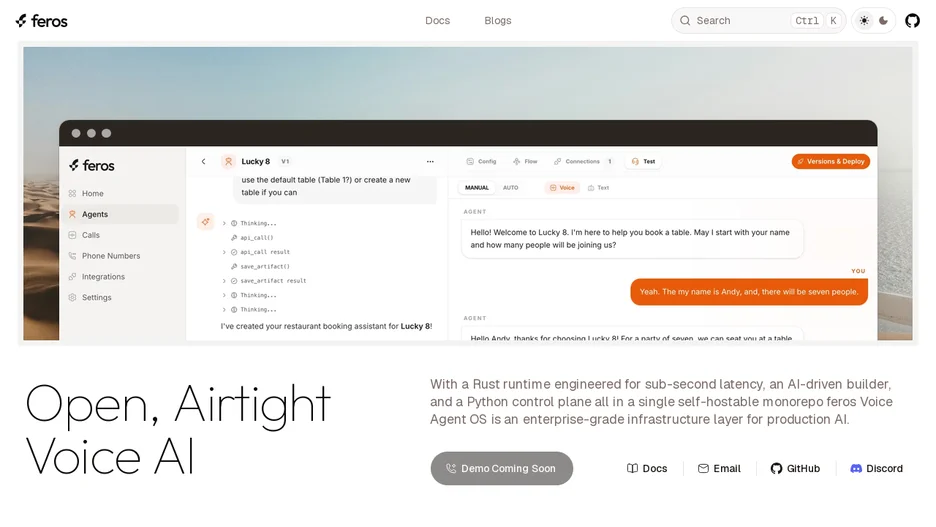
Feros Voice Agent OS is infrastructure for production voice AI, built as a single self-hostable monorepo. A Python control plane handles configuration and management, while a Rust voice runtime engineered for low latency handles every live call; the two layers scale independently, and components such as speech-to-text, the language model, text-to-speech and the telephony provider are each swappable.
It targets three alternatives: managed platforms such as Vapi or Retell, whose per-minute costs and lack of self-hosting or data-residency control it avoids by running entirely on the operator's own infrastructure; low-level frameworks such as Pipecat or LiveKit, by shipping a production-ready voice pipeline instead of requiring one to be built from scratch; and visual node-based builders, by having an AI provision an agent's tools, prompts and routing logic from a plain-language description instead of manual wiring.
Its dashboard and control-plane API sit in front of a Postgres database, and separate voice-server and voice-engine components handle telephony and browser calls.