

FunASR
An industrial speech recognition toolkit for training and running offline, streaming and edge automatic speech recognition, voice activity detection, punctuation restoration and speaker diarization models, with OpenAI-compatible and MCP serving.
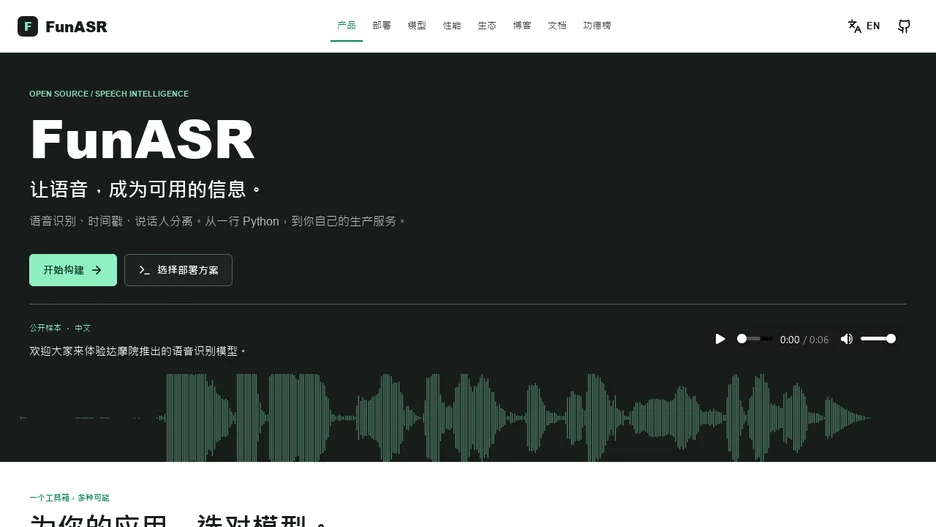
FunASR is a speech recognition toolkit covering the full pipeline from training to inference: automatic speech recognition, voice activity detection, punctuation restoration, speaker diarization, and emotion and audio-event tagging, for offline, streaming and edge deployment.
Its models include SenseVoiceSmall for file transcription with emotion and event tags across five languages, Fun-ASR-Nano and Fun-ASR-MLT-Nano for LLM-based file transcription in more languages, and a streaming Paraformer checkpoint for chunked live transcription. Models are used through a Python AutoModel API, a GPU-oriented vLLM path, or a streaming SDK and WebSocket service.
FunASR serves models through an OpenAI-compatible API and an MCP server for use from coding agents, and integrates with frameworks such as LangChain, Dify and AutoGen. It is written in Python and installs from PyPI.