

GoClaw
A multi-tenant AI agent gateway written in Go that rebuilds OpenClaw with multi-tenant PostgreSQL isolation, layered permission controls and native concurrency for deploying AI agent teams at scale.
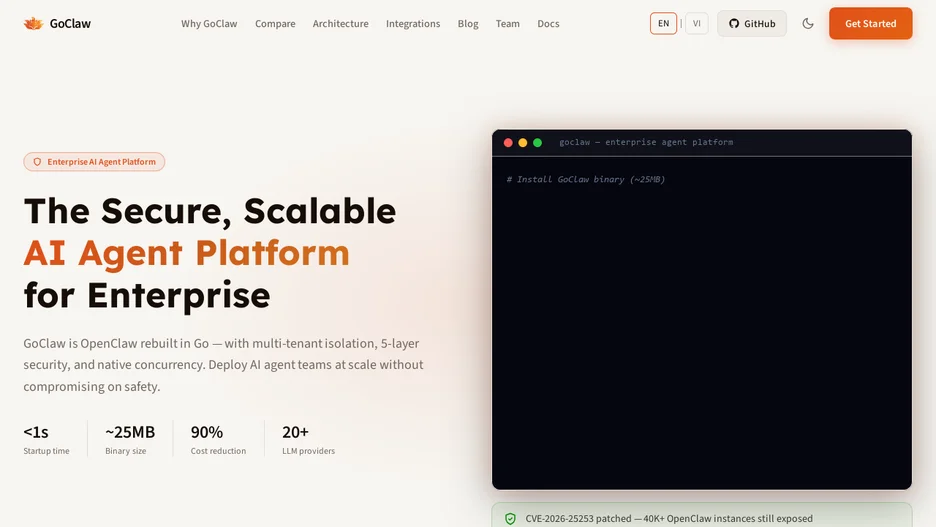
GoClaw is a multi-agent AI gateway, described as OpenClaw rebuilt in Go, aimed at running multiple AI agent teams for many separate users or tenants without compromising on safety. It supports more than 20 LLM providers and seven messaging channels, including Telegram, Discord, Slack and WhatsApp, backed by multi-tenant PostgreSQL storage.
Its architecture includes an eight-stage agent pipeline from context gathering through thinking, acting, observing and summarizing; a four-mode prompt system with section gating and cache-boundary optimization; three-tier working, episodic and semantic memory with progressive loading; a document-based knowledge vault with wikilink-style links and hybrid full-text and vector search; agent teams with shared task boards and synchronous or asynchronous delegation; and a five-layer permission system with rate limiting, prompt-injection detection, SSRF protection and AES-256-GCM encryption for per-user API keys.
It compiles to a single, roughly 25 MB static Go binary and requires PostgreSQL 18 with pgvector.