

GoRaven
A self-hosted, team-oriented AI agent platform where each member gets an isolated agent workspace that reads files, runs shell commands, calls APIs and retrieves from a shared knowledge base to complete assigned tasks.
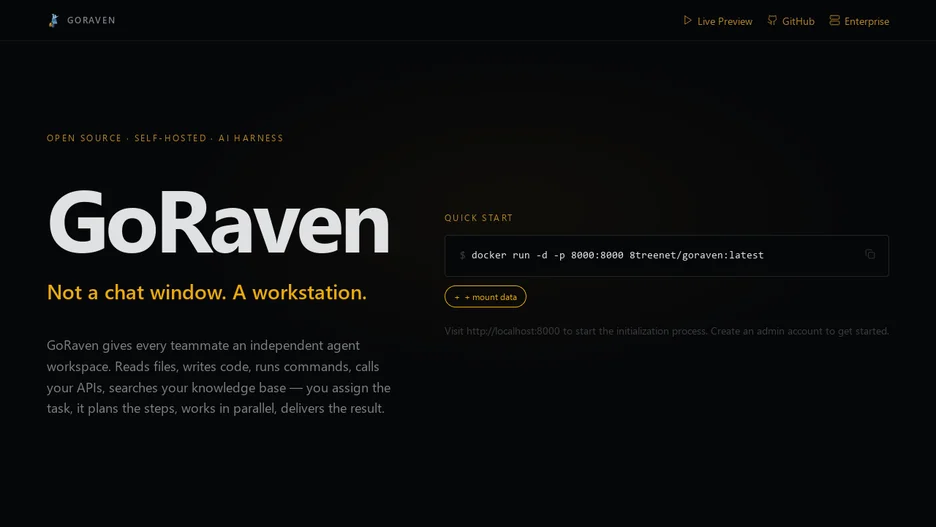
GoRaven gives every person on a team an independent AI agent workspace rather than a shared chat window. An agent reads and writes files, runs shell commands, calls internal or external APIs, searches a shared knowledge base, analyzes data and produces reports and charts, breaking an assigned task into parallel work and delivering a finished result rather than a block of text to copy and paste.
Administrators control model quotas, tool permissions and data access across the team, and prompts, scripts and workflows can be packaged as reusable skills in a shared marketplace that the whole team can install and maintain centrally. Company policies, documents and other material can be indexed into retrieval-augmented generation so agents cite sources rather than answer from memory alone, and plugin hooks let an operator inject custom logic before or after conversations, tool calls, or streamed events without forking the core application.
It runs as a single Docker container, keeps data on the operator's own server, and works with OpenAI, Claude, DeepSeek, Qwen or GLM models, or any compatible API.