

hacker-laws
A reference of named laws, theories, principles and patterns that come up when discussing software development, from Conway's Law to SOLID.
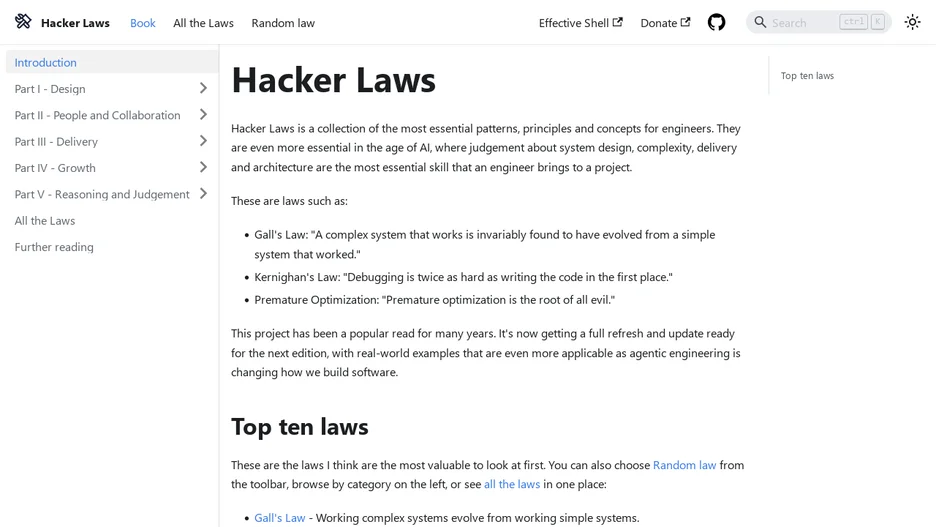
hacker-laws is a reference and overview of laws, theories, principles and patterns commonly discussed in software development and technology. Its laws section covers items such as the 90-90 rule, Amdahl's Law, the CAP theorem, Conway's Law, Cunningham's Law, the Dunning-Kruger effect, Hofstadter's Law, Metcalfe's Law, Moore's Law, Murphy's Law, Parkinson's Law and the Unix philosophy, among many others.
A principles section covers ideas such as Chesterton's Fence, Kerckhoffs's principle, the Pareto principle, the robustness principle (Postel's Law), SOLID and its five component principles, the DRY principle, KISS, YAGNI, the fallacies of distributed computing, and the principle of least astonishment.
The project also links to a reading list, related online resources and a podcast episode discussing the material, and the author notes the repository may eventually be turned into a book. It is released under the CC-BY-SA-4.0 license and has been translated into a number of languages.