

Hallmark
A design skill for AI coding agents such as Claude Code, Cursor and Codex that builds web page UI while avoiding common AI-generated design defaults, using a set of automated checks.
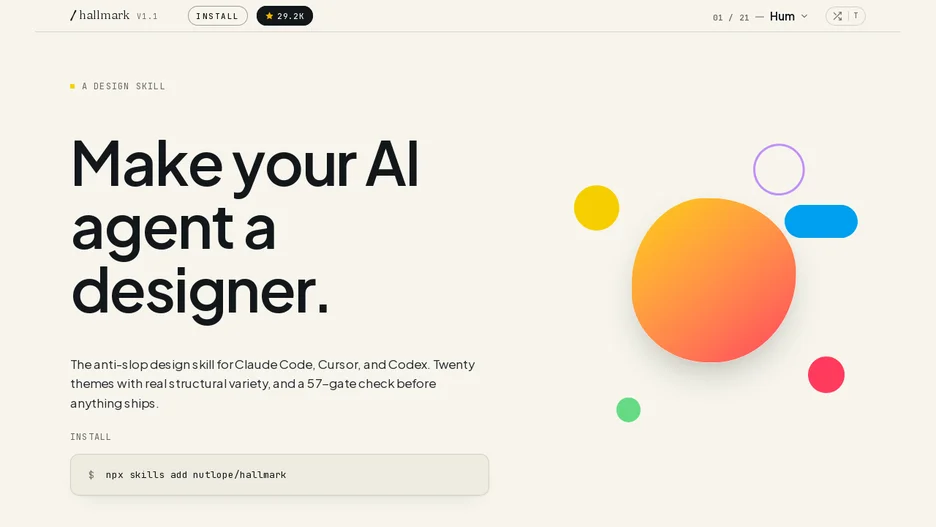
Hallmark is a design skill for Claude Code, Cursor and Codex that generates web page UI while avoiding common AI-generated design defaults. For a given brief, it picks a page macrostructure and one of twenty-one visual themes, then runs fifty-seven checks plus a self-critique pass before returning the result, aiming to make two different briefs produce visually distinct pages rather than colour variations of one template.
It offers four commands: a default build command; an audit command that scores existing code against the same anti-patterns without editing it; a redesign command that keeps a page's copy, information architecture and brand while rebuilding its structure; and a study command that extracts the macrostructure, type pairing and colour anchor from an admired design, optionally producing a portable design document. A custom mode designs a page from scratch when no catalog theme fits the brief.
Each generated page is self-contained HTML and CSS. It installs as a skill through the skills command-line tool or by copying its files into a Claude Code or Cursor skills folder, and is licensed under the MIT license.