

Heed Wake Word
An Apache-2.0 toolkit for training a custom wake word and running it fully on-device in Python, the browser, or on iOS and Android.
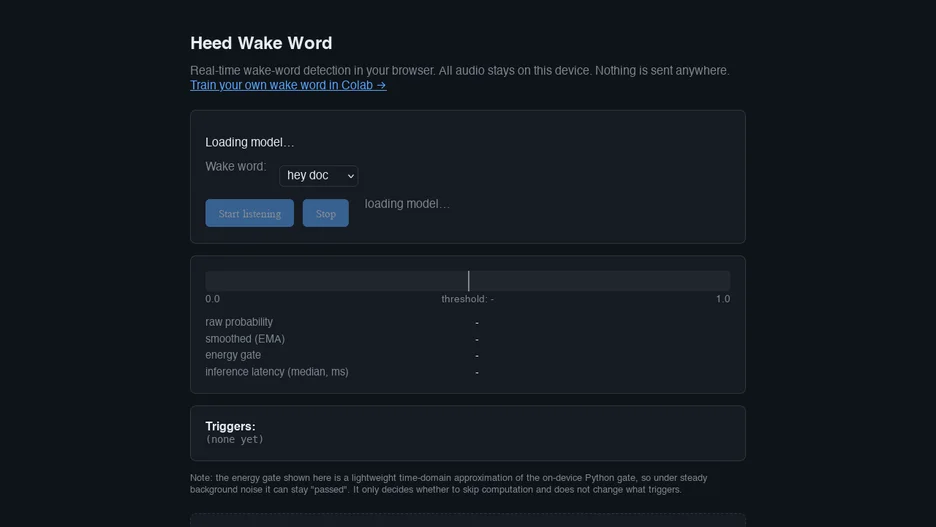
Heed lets someone train their own wake word, or use a ready-made one, and run the resulting model entirely on-device. A trained model is a 40 to 235 KB file that runs the same way in Python, in the browser and on iOS and Android, so audio never leaves the device and there are no per-call fees.
Training works by recording a phrase a few times or having text-to-speech synthesize it across hundreds of voices, then training on CPU or GPU in seconds and exporting an ONNX or TFLite model together with a preprocessing contract file. A browser-based studio and a CLI drive the same workflow, and training can also run for free in Google Colab with no local setup.
Heed positions itself against established options such as Picovoice's Porcupine, openWakeWord and LiveKit, for the specific case of a fully permissive, train-your-own wake word that also runs client-side in the browser.