

Hexabot
An AI workflow automation platform that combines YAML-defined workflows, actions, agents, and conversational channels, with tools, MCP, memory, and retrieval-augmented generation, in one runtime.
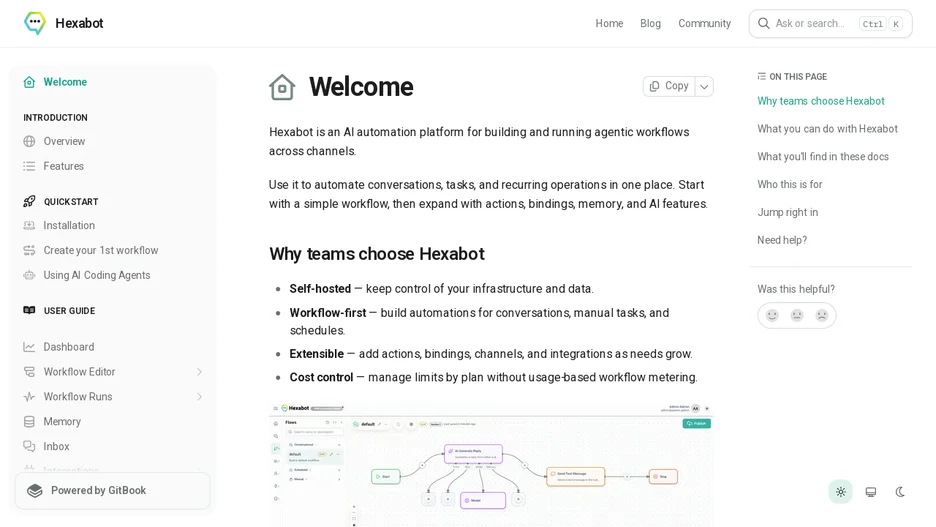
Hexabot v3 is an automation platform with first-class AI capabilities, combining workflows, actions, and conversational channels in one runtime. Workflows are defined in YAML with typed runtime contracts, actions define workflow behavior with schema-validated inputs, outputs, and settings, and a binding system separates reusable capability and configuration bindings from task logic; the platform supports explicit memory definitions, MCP integration for tool and context interoperability, and multi-channel continuity across conversational surfaces.
A project is created and run through a CLI installed with npm, which scaffolds a new project, auto-detects the package manager, and starts a development server with an admin UI, an API, and non-production API documentation each on their own local endpoint; hexabot create requires an interactive terminal for its initial admin-credential prompts. The CLI also handles environment configuration, health checks, and database migrations.
Its schema-first architecture uses Zod broadly for validation and shared contracts across the platform.