

HybridClaw
A self-hosted AI assistant runtime meant to run real business workflows, such as CRM, marketing and finance tasks, reliably on smaller local models, with credentials kept out of the model's context and every action gated by approval tiers.
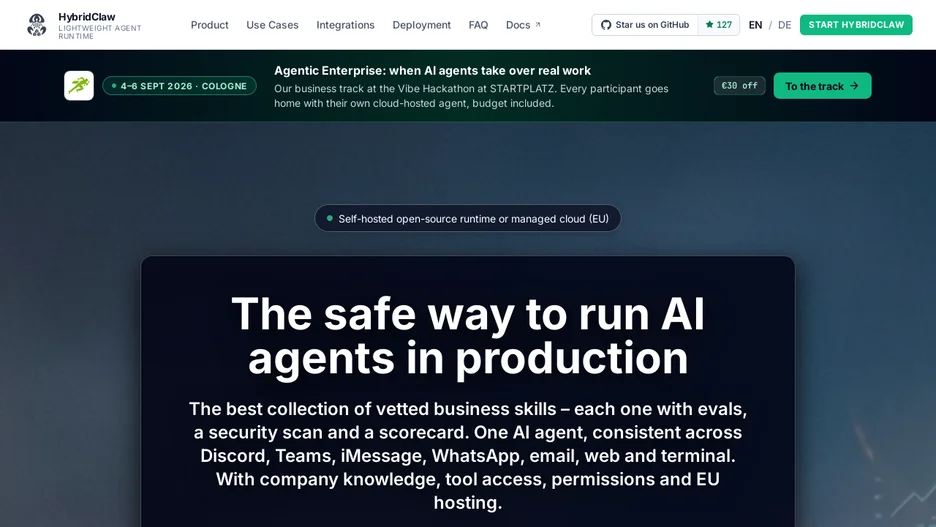
HybridClaw bundles business-skill helpers for tools such as Salesforce, HubSpot, GA4, Google Ads, Airtable, Miro, Zoho, Microsoft 365, warehouse SQL, invoicing and cloud operations, implemented as tested helpers with evaluation scenarios and credential boundaries, and validated against a compact model as its baseline rather than assuming a frontier model is available.
Agents can address one another as networked coworkers, whether running locally, through a hosted proxy, or as trusted peer HybridClaw instances, exchanging end-to-end encrypted agent-to-agent messages through approval-aware channels; a local mode can keep peer delivery and administration reachable while disabling other external gateways. Secrets stay outside the model's context in an encrypted runtime store, with tools resolving them only at execution time so the model sees the requested action rather than the underlying credential.
It is written in TypeScript and can run as one local assistant, a fleet of role-specific agents, or a hosted cloud instance.