

hyperresearch
A deep-research skill for Claude Code and OpenAI Codex that runs a multi-step research pipeline over many web sources, verifies citations and builds a persistent, searchable vault of prior findings.
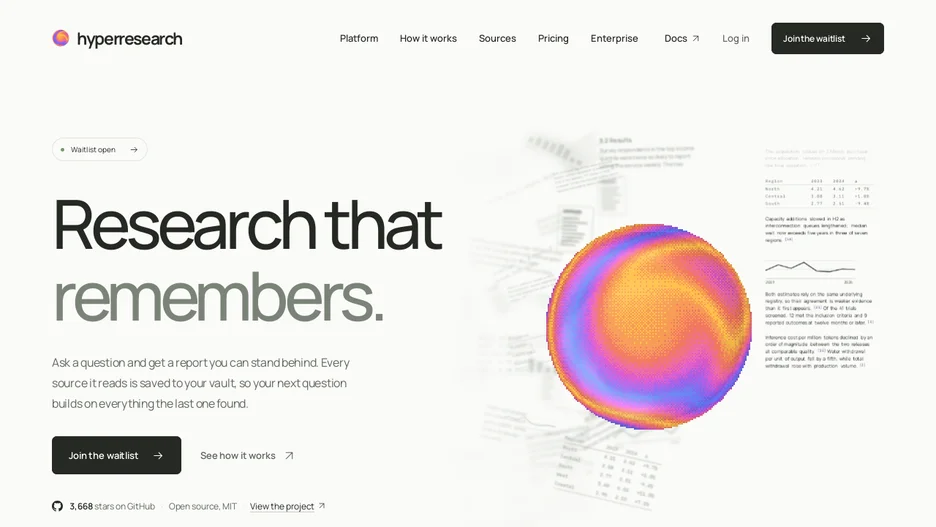
hyperresearch turns Claude Code, and separately OpenAI Codex, into a deep-research agent through a tier-adaptive, multi-step pipeline that takes one prompt and produces a report with full source provenance. Every source it reads is stored in a persistent, searchable vault, so a later research session can build on what an earlier one already found instead of starting over.
Its higher scale profiles target more than a hundred sources per run through citation chasing and gap-fill fetching, and every citation is checked by a separate auditing pass before the report ships, treating a hallucinated quote or an unacknowledged retraction as a hard block. An independence audit clusters derivative copies of the same underlying source so that reprints of one press release do not count as several independent sources, and several critics attack a draft in parallel while a tool-restricted patcher applies only surgical edits, so a draft cannot rewrite the whole report on its own. A dedicated search command queries several scholarly and public-records sources, including OpenAlex, Crossref, SEC EDGAR and FRED, through one client and deduplicates the results.
It installs as a Python package.