

Knowledge Agent Template
Knowledge Agent Template is an open-source, forkable starting point for an AI agent that answers questions from a knowledge base using grep, find and cat inside a sandbox, with no embeddings or vector database, deployable as a chat, GitHub or Discord bot.
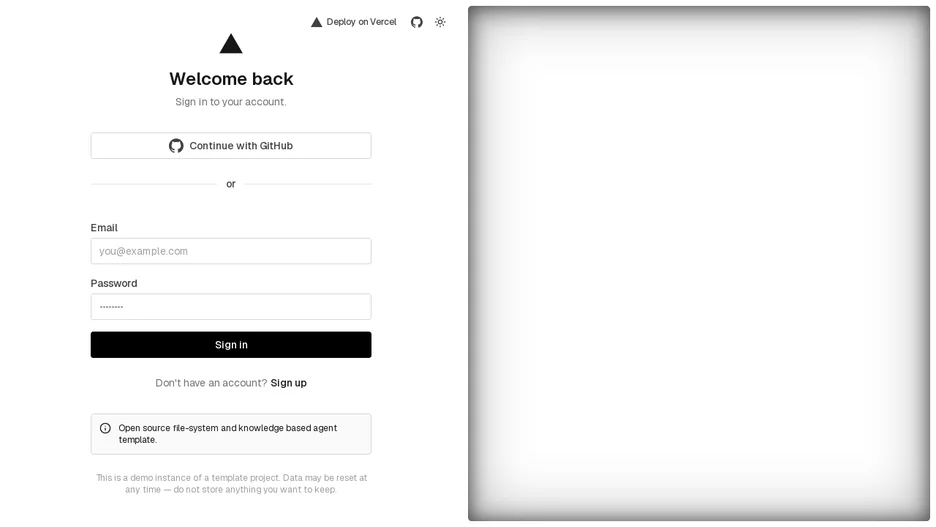
Knowledge Agent Template is an open-source template for building a file-system and knowledge-based AI agent that stays current with its sources. Instead of an embeddings and vector-database pipeline, agents search across sources such as GitHub repositories, YouTube transcripts or custom APIs using grep, find and cat inside isolated sandboxes, producing deterministic and explainable results with no separate indexing infrastructure.
The same agent can be deployed as a web chat app, a GitHub Issues bot or a Discord bot through pluggable adapters, and it ships a built-in admin panel with usage statistics, error logs and source configuration, plus an AI-powered admin agent that answers operational questions such as recent errors or slowest endpoints. A complexity router sends simple questions to cheap models and hard ones to more capable models, and a pooled sandbox reuses already-running sandboxes to cut startup time.