

Kubetorch
A Python framework for building, iterating on and deploying machine learning workloads on Kubernetes, bringing cluster compute into a local development workflow with fast iteration.
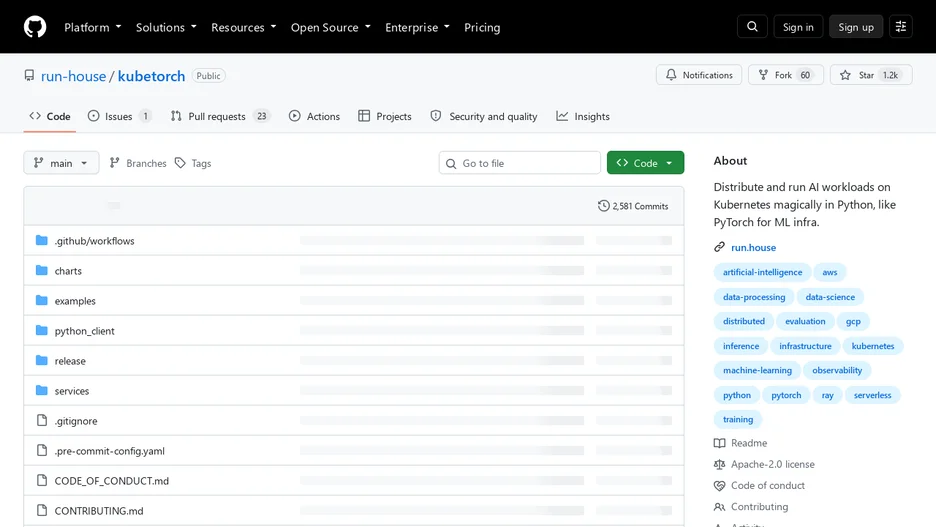
Kubetorch lets developers programmatically build, iterate on, and deploy machine learning applications on Kubernetes directly from Python. It brings a cluster's compute into the local development environment so changes can be tested in one to a few seconds instead of the minutes a full redeploy usually takes, and it propagates logs, exceptions and hardware faults back to the caller in real time.
Because it has no local runtime or code-serialization step, it can be used from an IDE, a notebook, a CI pipeline, or production code, the same way a local process pool would be used, while the actual work runs on cluster compute. The project reports large reductions in iteration time, compute cost, and production faults, from resource allocation, bin-packing and dynamic scaling.
It installs as a Python client with pip, and the cluster side deploys with a Helm chart; a fully managed serverless version is also offered.