

Lattice
A set of composable AI skills, organized into small guardrails, multi-step workflows, and guided interviews, that push a coding assistant toward design-first, standards-aware development.
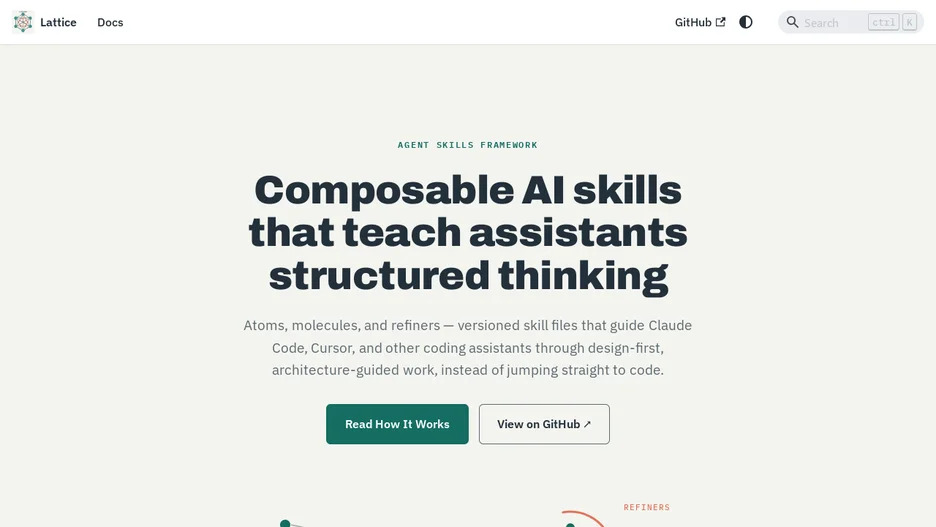
Lattice packages engineering discipline as composable skills for AI coding assistants, aiming to stop an assistant from jumping straight to code, silently making design decisions, or losing track of constraints mid-conversation. Skills are organized into three tiers: atoms are single-principle guardrails, such as clean code, architecture, domain-driven design, or secure coding; molecules are multi-step workflows, such as design, implement, refactor, fix, or review, that compose several atoms together; and refiners are guided interviews that produce project-specific standards, tailoring how the atoms behave for a given team.
A full delivery pipeline chains a requirements stage, a design-blueprint stage, an implementation stage, and review, with separate paths for refactoring and bug fixes, and an architecture-review step that interviews an existing codebase before any of this runs. Each stage reads and writes to a living project folder that accumulates a project's standards and decisions across feature cycles. It installs as a Claude Code plugin, which Cursor can also read directly.