

laya
A multilingual, non-autoregressive decision engine that returns typed choice, score and yes/no judgments over text in a single forward pass, across more than 100 languages, with automatic routing to the right checkpoint.
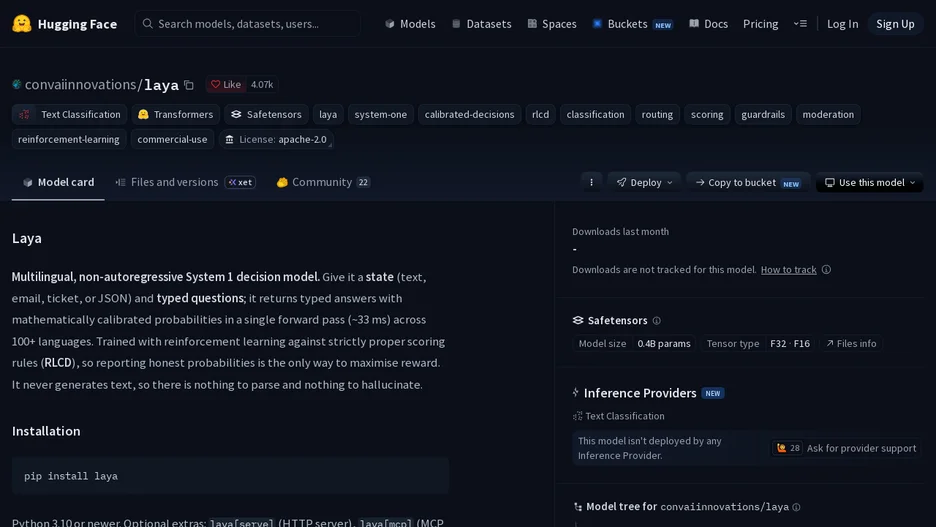
laya is a multilingual, non-autoregressive System 1 decision engine. It returns typed decisions, such as a choice from a set of options, a score, or a yes/no answer, over text in more than 100 languages in a single forward pass, taking about 33 milliseconds, and was trained with reinforcement learning against strictly proper scoring rules.
A router automatically picks the right checkpoint for each request, including a long-context, multilingual checkpoint that can read up to 8,192 tokens instead of the default 1,024-token limit; response time follows the input's real length rather than the configured limit. The router also detects the script and language of non-English text and routes it to the multilingual checkpoint automatically.
It installs with pip or uv, requires Python 3.10 or newer, and has optional extras for an HTTP server, an MCP server, LangChain and LangGraph, LlamaIndex, CrewAI, ONNX Runtime and a GPU fast path; a separate TypeScript/Node.js/browser package, laya-ts, is also published. It is licensed Apache-2.0.