

Learn Claude Code
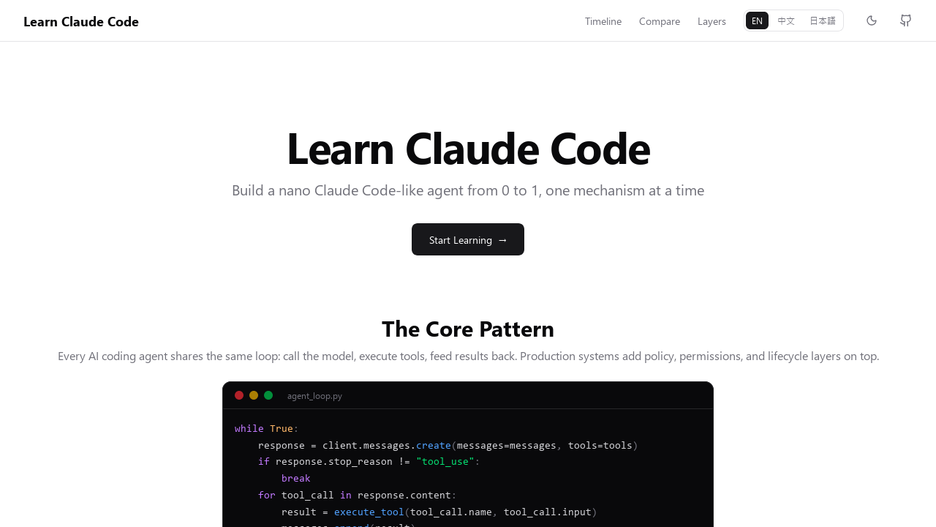
A teaching repository explaining agent-harness engineering: how a coding-agent product pairs a trained model with the surrounding tool, memory and sandbox infrastructure, building a minimal agent from first principles.
The project argues that agency, the ability to perceive, reason and act, comes from a model's training rather than from surrounding orchestration code, and walks through historical examples such as DeepMind's Atari-playing DQN, OpenAI Five, AlphaStar and Tencent's Jueyu system to make the point before turning to modern LLM coding agents.
It distinguishes a model's trained agency from the harness that gives it tools, memory, loops and sandboxes to operate in a real environment, and pushes back on treating an assistant's surrounding prompt-and-tool scaffolding as agency in itself. From that framing it builds a small agent step by step to show what a harness actually needs to provide.
Available in English, Chinese and Japanese. Python, MIT licensed.