

LeastAction
A self-hosted platform where an AI operator builds, deploys, runs, debugs and reruns data pipelines against a team's existing databases, warehouses and APIs.
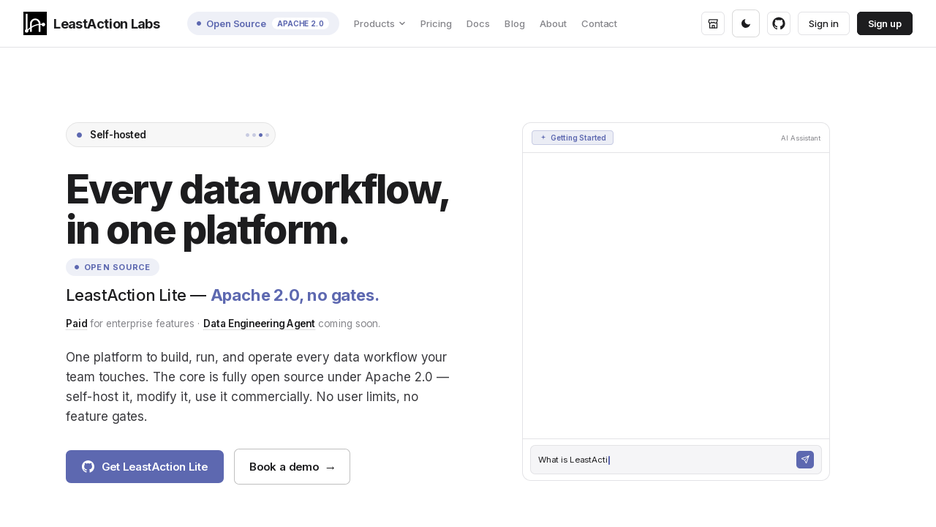
LeastAction gives an AI system an operator role over data workflows: it generates the pipeline code, deploys it, runs it, reads the logs, queries the resulting data, diagnoses a failure, fixes the code, and reruns it, without a human at each step. It works against infrastructure a team already has, such as PostgreSQL, Athena, Redshift, BigQuery, S3, Lambda, dbt or Airflow, without requiring migration.
Every task combines an operator (the code that runs, written in Python or generated by AI), a connection (credentials and concurrency limits for an external system), a payload (the run's specific parameters) and a config (schedule, retries, SLA and dependencies). Everything is organized in a shared catalog of operators, connections, tasks and reports that both the AI and the team use to schedule, monitor and reuse pipelines, with per-connection parallelism, native Git CI/CD, and one-click backfill for any task and date.
It is self-hosted, with one instance per team.