

LlamaFactory
LlamaFactory is a zero-code CLI and web UI for fine-tuning more than a hundred open large language and vision-language models, from LoRA adapters through full-parameter training.
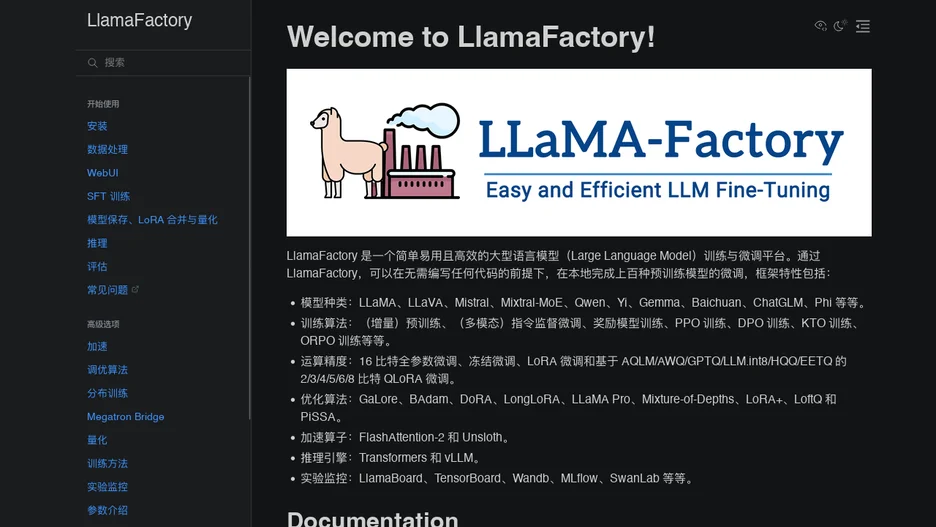
Supported model families include LLaMA, LLaVA, Mistral, Qwen3, DeepSeek, Gemma, GLM and Phi, with training approaches spanning continuous pretraining, multimodal supervised fine-tuning, reward modeling, and preference-optimization methods such as PPO, DPO, KTO and ORPO. Scalable resources range from 16-bit full tuning to 2- through 8-bit QLoRA via several quantization backends, alongside newer algorithms like GaLore, DoRA and LongLoRA and practical speedups such as FlashAttention-2 and Liger Kernel.
It handles multi-turn dialogue, tool use, image understanding, visual grounding, video recognition and audio understanding, logs experiments to TensorBoard, Wandb, MLflow or SwanLab, and serves trained models through an OpenAI-style API backed by vLLM or SGLang, alongside a LLaMA Board web GUI and a Docker build path.
The README states it is used internally by companies including Amazon, NVIDIA and Aliyun. Python, Apache-2.0.