

LongHorizon-Harness
A loop-engineering harness that turns existing coding agents into long-running, computer-use systems able to work across desktop apps and a terminal for dozens of hours.
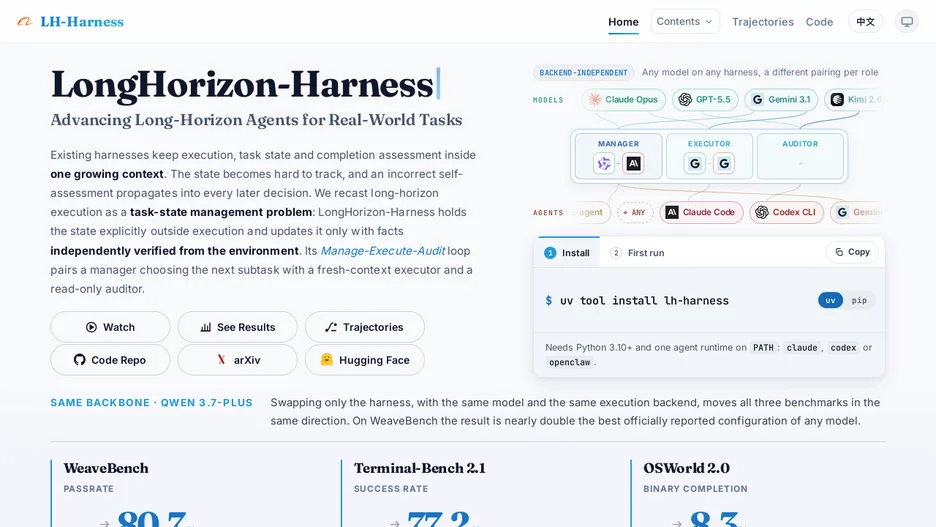
LongHorizon-Harness gives an existing agent, such as Claude Code, Codex, OpenCode or DeepSeek Harness, a goal once and keeps it working across desktop applications and the terminal CLI for extended periods, rather than training a new model or replacing the agent itself. It continuously recovers the goal and verified state, plans the next bounded step, executes it with a fresh context, checks the actual result in the real computer, and then checkpoints accepted progress or feeds failure evidence into the next round.
It installs with a one-command setup and supports role-scoped read and write permissions, independent per-role model selection through a web workbench, and normalized JSON results across the different agent backends it wraps. A finished run stays open for follow-up: a message sent mid-round is claimed by the very next round instead of being lost, and a graceful stop only escalates to a forced stop when a worker ignores it.