

loomcycle
A self-hostable agentic runtime that runs as one Go binary alongside your application, handling the agent loop, multi-provider LLM routing, memory, and MCP on both sides, reachable over HTTP, gRPC, MCP, or TypeScript/Python adapters.
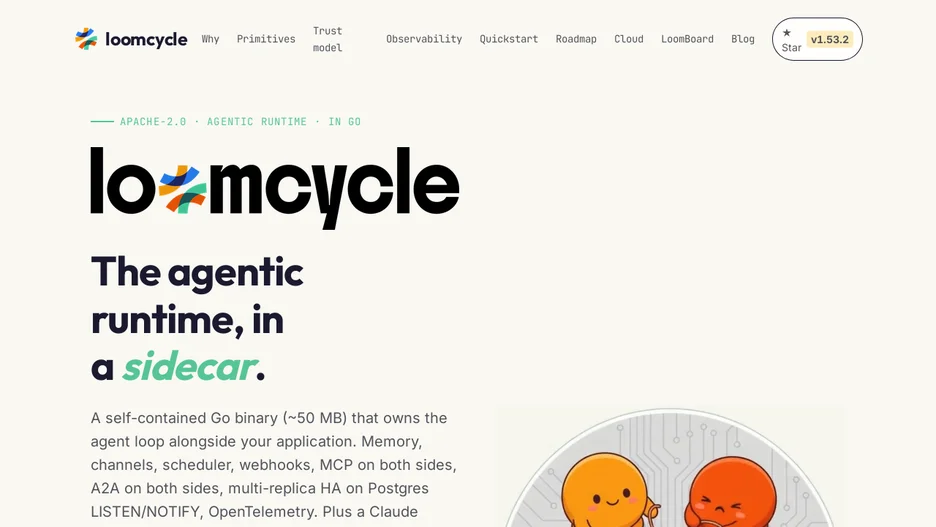
loomcycle is a sidecar agentic runtime: one roughly 50 MB Go binary that runs next to an application rather than embedded inside it. The host application calls loomcycle over HTTP, gRPC, MCP, or a TypeScript or Python adapter, while the agent loop, multi-provider model routing, memory and channel primitives, MCP server identity, OpenTelemetry tracing, and multi-replica coordination all live inside the binary, so the application itself can stay in whatever language it was written in.
Providers include Anthropic, OpenAI, DeepSeek, Gemini, and Ollama (cloud and local) over native HTTP behind one interface, with config-driven routing, per-tier fallback cascades, model aliases, and a deterministic zero-token-cost synthetic provider for testing. Built-in tools cover file read/write/edit, search, HTTP, web fetch and search, shell execution, and memory/recall.
The project describes itself as past v1.0, feature-complete, and validated by an 8-hour soak test of 1.27 million circuits and 3.8 million agent runs with zero leaks; it distributes through Homebrew, multi-arch Docker images, a Claude Code plugin, and adapters, under Apache-2.0.