

Loop Library
A public catalog of reusable AI-agent workflow loops, repeatable playbooks that check their own results and decide what to do next, plus an optional installable skill for finding and publishing them.
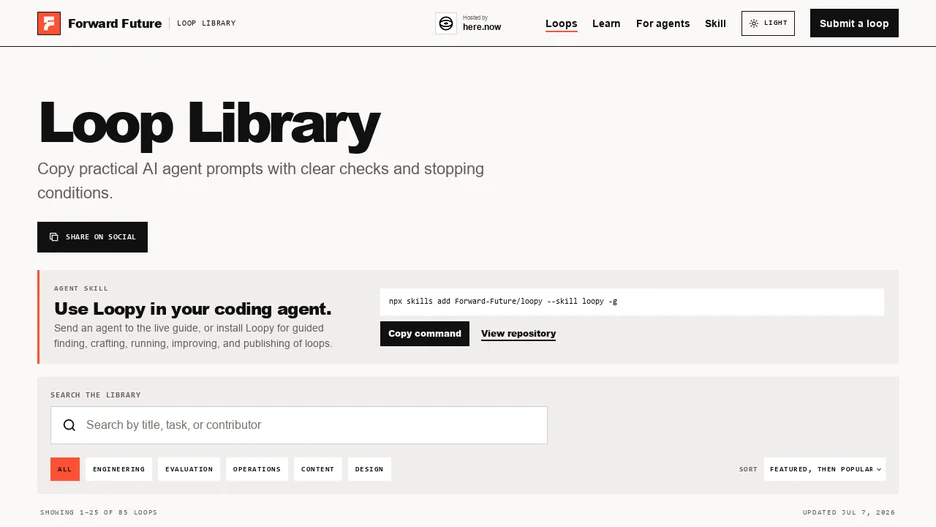
Loop Library has two related parts: a public website catalog where anyone, human or agent, can browse, read and copy the prompts of published agent loops with no installation required, and Loopy, an optional installable skill that helps an agent discover, audit, repair, craft, run, debrief, save or publish loops, using the website's live catalog when it recommends or publishes one.
A loop, as the project defines it, is a playbook with feedback built in: unlike a one-shot prompt, it tells an agent what it is trying to accomplish, how to judge whether the latest attempt worked, what to do with what it learned, and when to stop or ask for help, which suits tasks like fixing production errors or improving test coverage where the first attempt is rarely the final answer.
Agents without Loopy installed can still use the catalog directly through a published agent guide or plain-text and JSON catalog files. It is written in JavaScript and released under the MIT license.