

Ludwig
A declarative deep-learning framework, hosted by the Linux Foundation, for training, fine-tuning and deploying large language models and other AI models from a YAML configuration file instead of custom code.
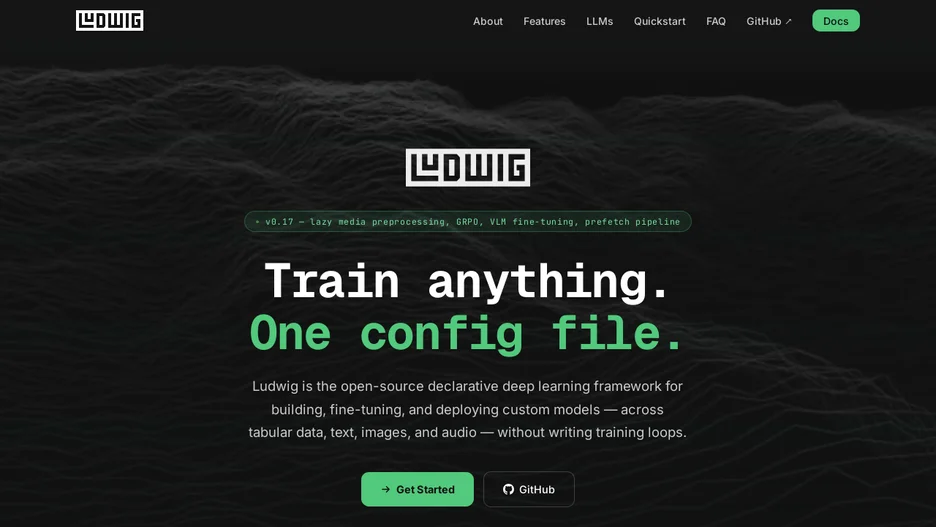
Ludwig is a declarative deep-learning framework that trains, fine-tunes and deploys AI models, from large-language-model fine-tuning to tabular classification, using a YAML configuration file rather than custom Python code; it is hosted by the Linux Foundation AI and Data organization and built on Python, PyTorch, Pydantic, Hugging Face Transformers and Ray.
Its most recent release adds time-series forecasting encoders, a wider set of parameter-efficient fine-tuning adapter types, vision-language model fine-tuning for models such as LLaVA and Qwen2-VL, a hypernetwork combiner that lets one feature generate weights for others, game-theoretic multi-task loss balancing, a command that has an LLM write a task's configuration file from a plain-language description, a model inspector for architecture analysis and feature importance, deployment integrations for Ray Serve and KServe, reward-model-free reinforcement learning from human feedback, native low-bit quantization with quantization-aware training, multiple named adapters with weighted merging, and a built-in hyperparameter-search executor.